
The Doors of London: Color in Regent’s Park, Black in Chelsea
When I was in London last month, I kept stopping to look at its front doors. Around Regent’s Park and in Chelsea, it was the color that caught my eye first. But the longer I looked, the more I noticed: the columns and carved surrounds, the fanlights above, the iron railings along the steps, and the façades that gave each entrance its setting.
A door on these streets is never just a door. It is the center of a whole composition, and often the most personal detail on the front of a house.
Colorful Front Doors Around Regent’s Park
The terraces surrounding Regent’s Park make an impressive backdrop for a walk. Developed in the early nineteenth century under the Prince Regent’s ambitious plans, their architecture is associated with John Nash and Decimus Burton. Long rows of houses were composed to resemble grand palaces, with pale stucco façades, columns, balustrades, and cornices.
Stucco gives these buildings much of their character. A plaster finish that can be shaped to suggest stone, it creates broad, light-colored surfaces against which a front door becomes especially striking.
In the streets around the park, the doors I photographed brought their own personalities to that architectural setting.
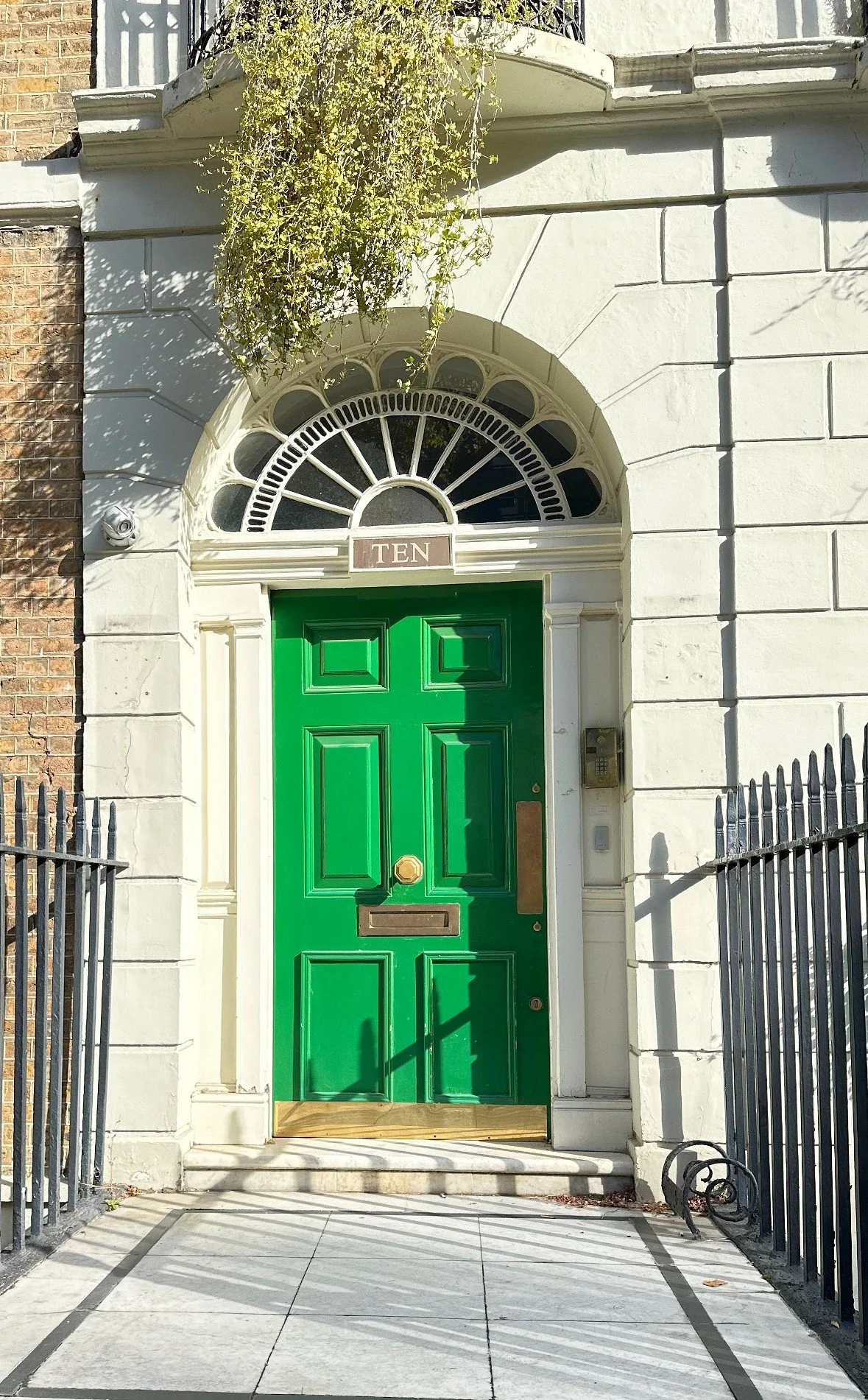
One was painted a vivid emerald green. Its six panels sat beneath a wide fanlight, with glazing bars spreading like the spokes of a wheel. The surrounding stucco was scored to resemble blocks of stone, and the word “TEN” appeared in brass above the entrance. The color was bold, but the orderly lines around it gave the whole doorway a sense of composure.
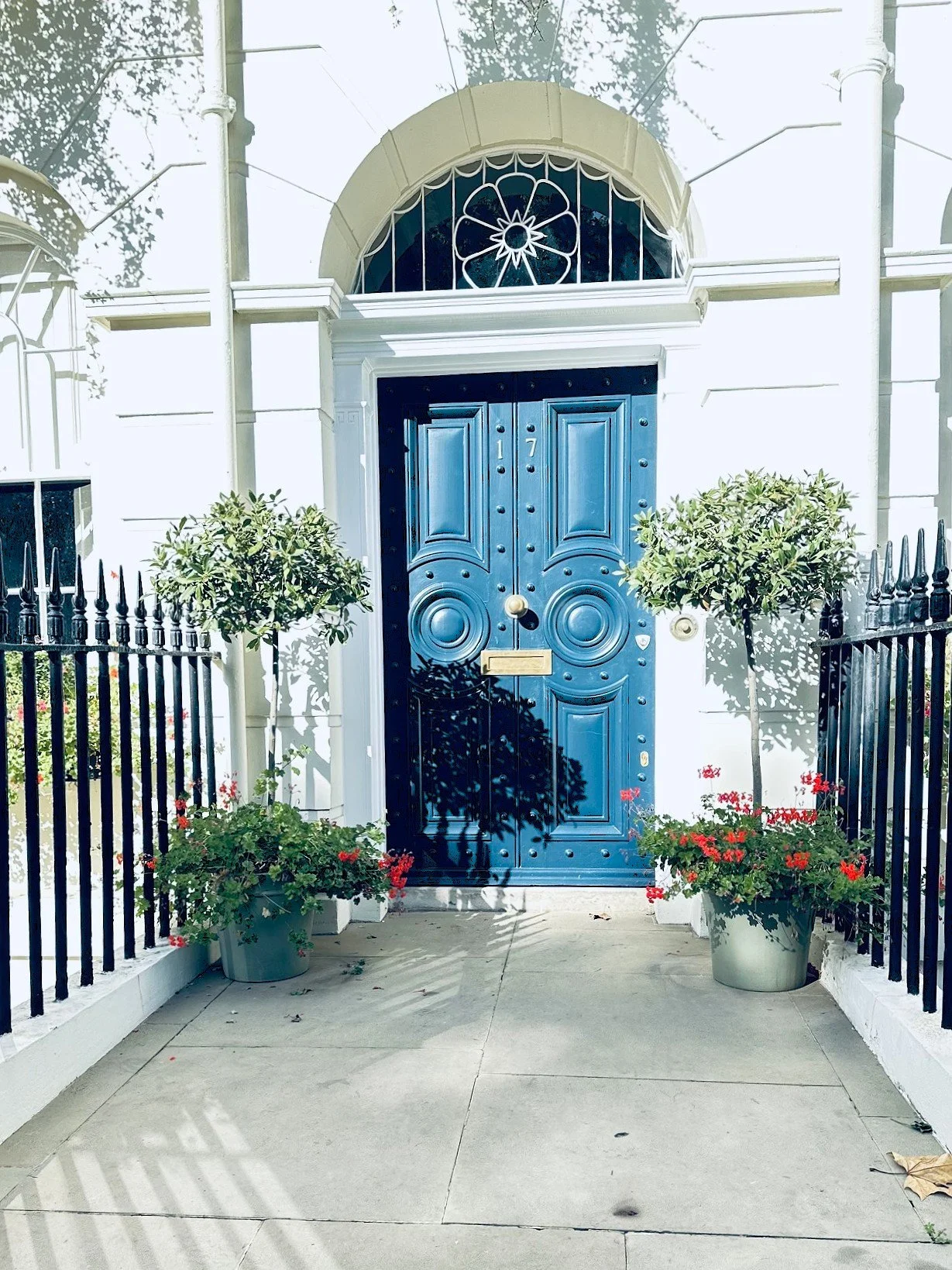
Another entrance, number 17, had a deep blue double door studded with small metal nail heads and decorated with two large circular bosses. Above it, the fanlight opened into a flower-like pattern.
Two small standard trees stood on either side in pale pots, with red geraniums planted beneath them. The repetition of the paired trees, the matching pots and the two halves of the door made the entrance feel considered. It suggested a welcome before I had even reached the step.
The Black Front Doors of Chelsea
Across town in Chelsea, near the Royal Hospital, the mood changed. Nearly every door I photographed was black, with one lovely exception.
After the green and blue doors around Regent’s Park, these Chelsea entrances made me look more closely at shape, finish, and hardware. Against a dark surface, a brass knocker or a curve of ironwork becomes more noticeable.
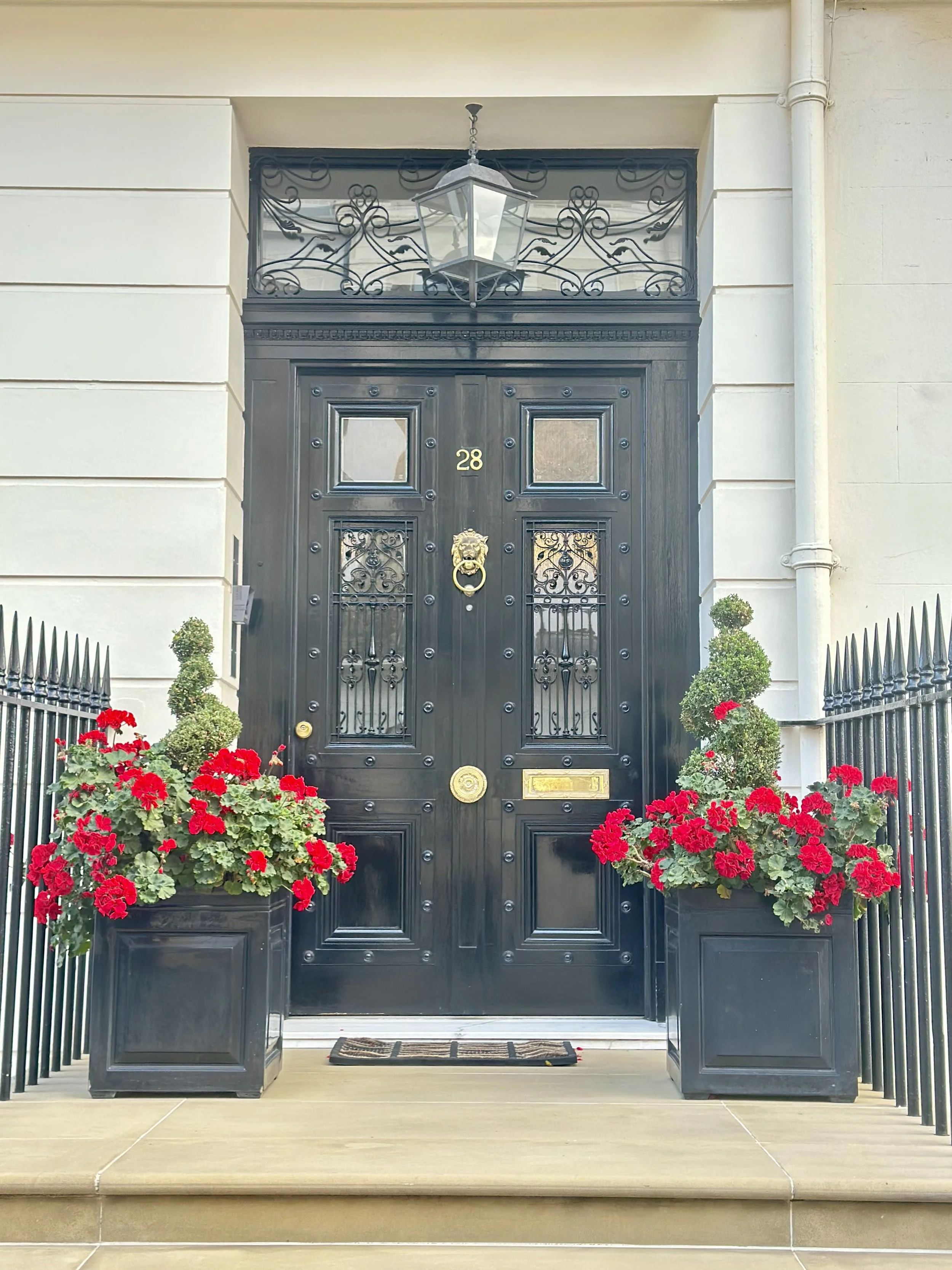
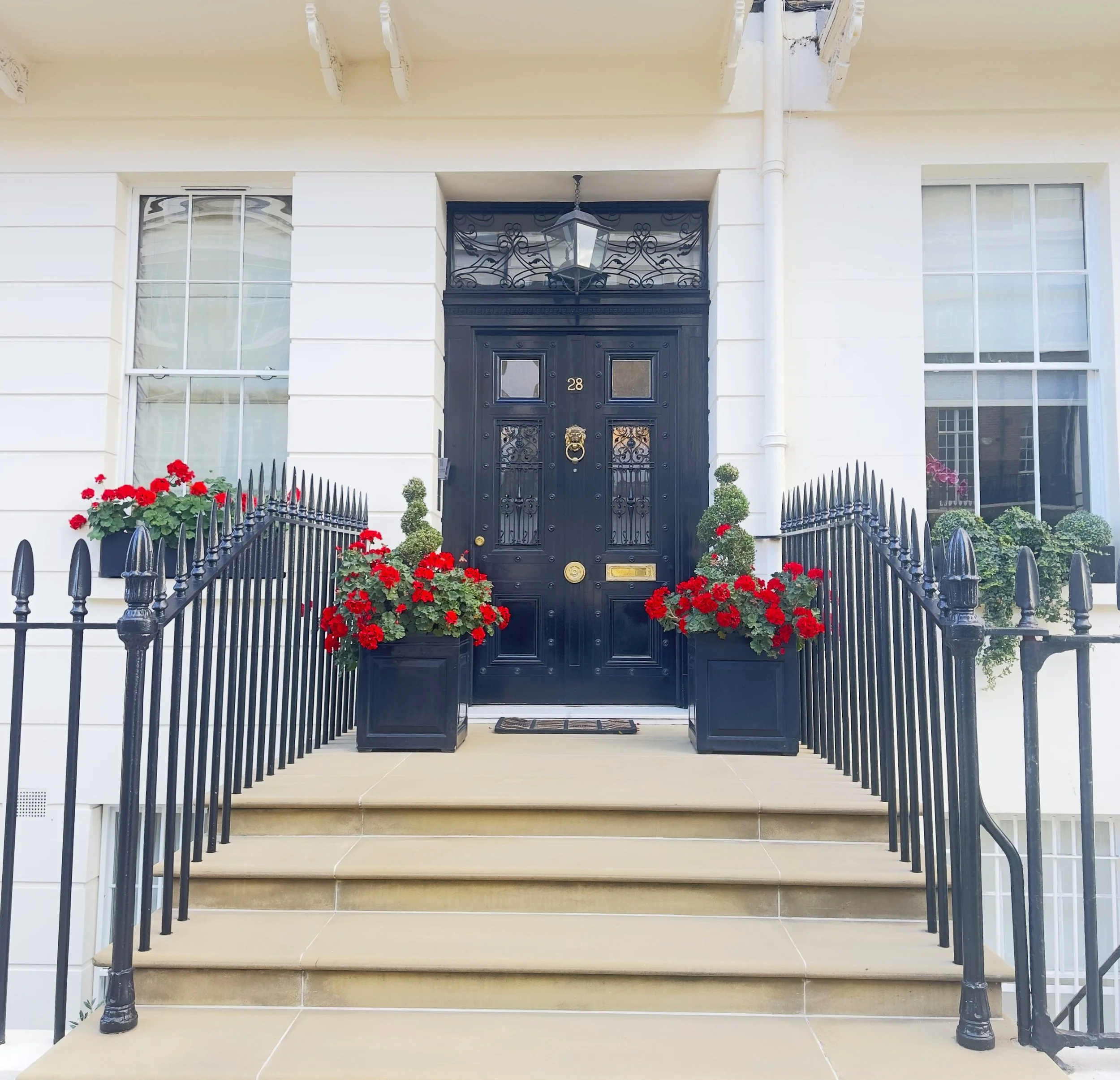
Number 28 was a glossy black double door, studded with nail heads and fitted with a brass lion’s-head knocker. Decorative ironwork screened its upper panels. Above it, scrolled metalwork framed a hanging lantern.
At the top of the stone steps, black planters held spiral topiary and red geraniums. The planting brought color to the entrance without competing with the door.
A black door can look severe, but this one did not. The shine of the paint, the brass, the greenery, and the intricate ironwork gave it a richness I had not expected.
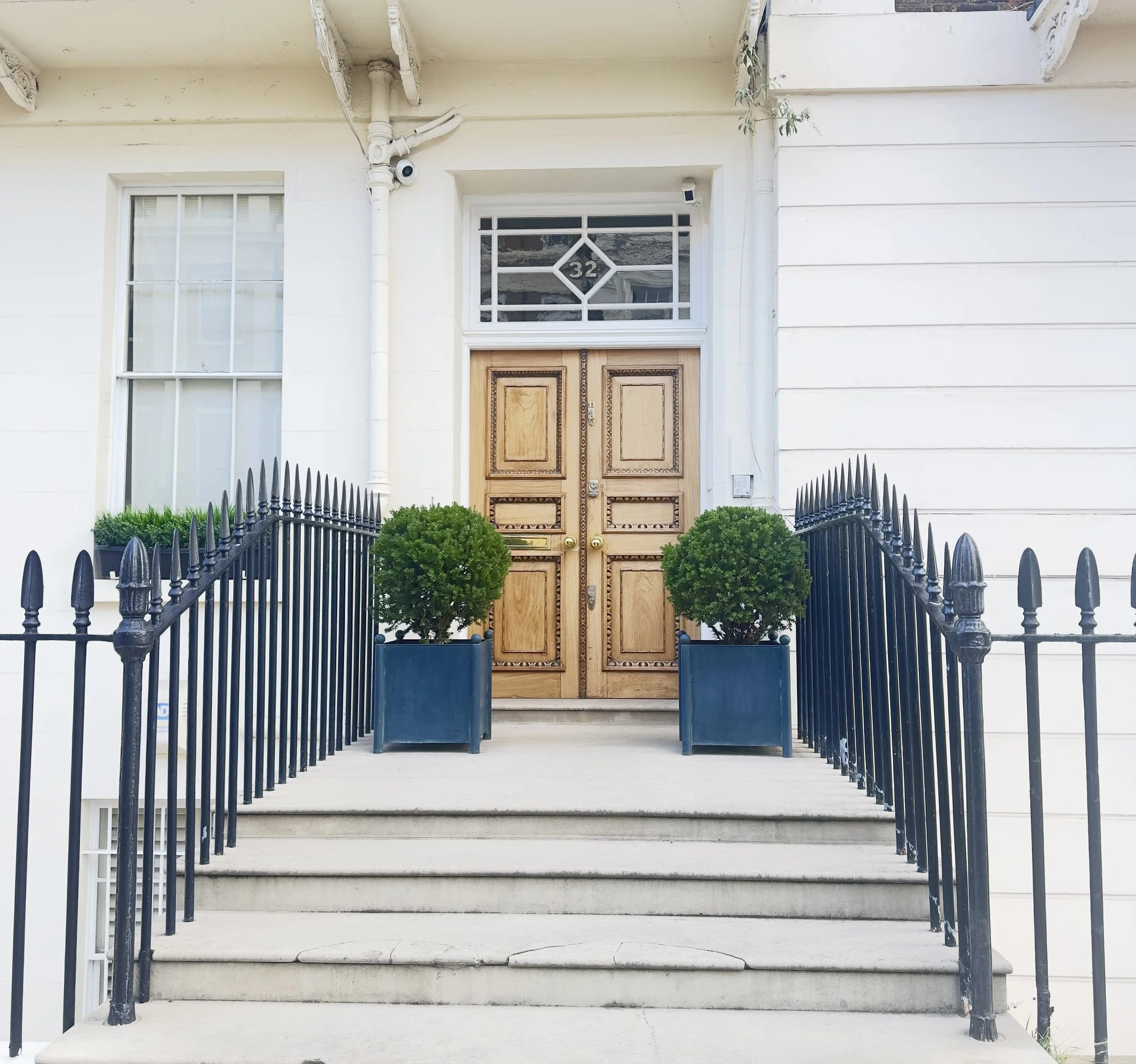
Number 32 had kept its natural wood. Its double doors were carved with a fine molding around every panel and finished with brass knobs and a brass letter plate. Above them, the number sat in a diamond at the center of a geometric transom window. Two clipped green globes stood in blue-gray planters at the top of wide stone steps, and with the black railings on either side, the warm wood looked all the richer for being left unpainted.
Georgian Front Doors, Fanlights and Victorian Details
Part of the pleasure of looking at London’s front doors is noticing how much happens around them.
Six-panel doors are a familiar feature of Georgian architecture. Fanlights, the glazed windows above many entrances, bring daylight into the hall while adding another decorative layer to the façade. Some are simple; others contain elaborate patterns of curved glazing bars.
Later doorways offer their own combinations of glazing, paneling, paint, and ornament. Over the years, these old doorways have been repainted, refitted, and cared for by one owner after another, so what you see today is a mix of the original architecture and the choices of the people who live there now.
A door color may be a recent choice. The proportions of the opening, the steps, and the surrounding masonry may tell a much older story.
Beyond London: A Red Door in Cheltenham
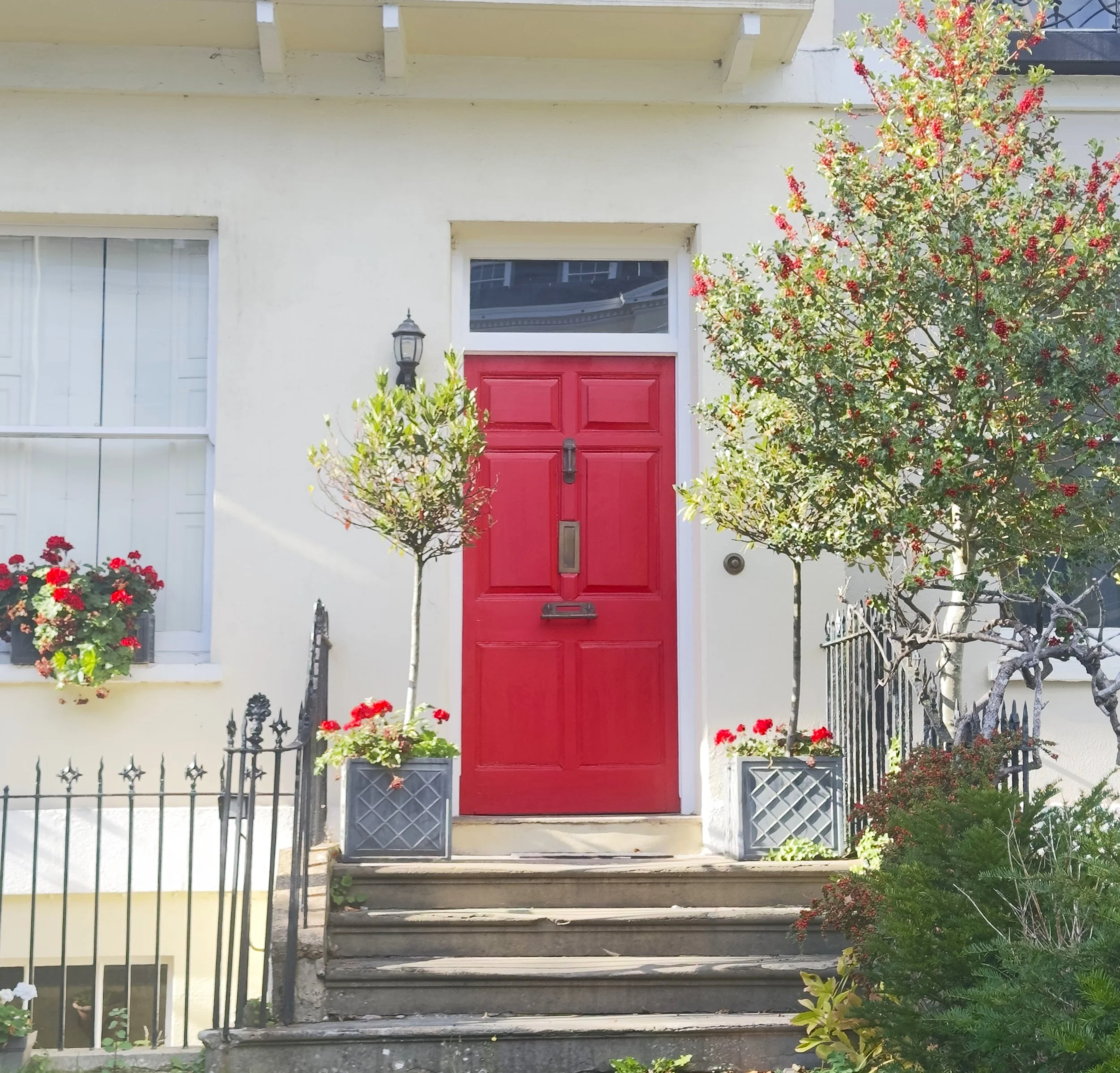
One more door has stayed with me, though it is not in London at all. While staying in Cheltenham, at the edge of the Cotswolds, I came across a red front door in a town known for its Regency architecture. It was a classic six-panel door, painted a clear, glossy red, with a black knocker, a letter plate and a plain window above it. Two small standard trees stood on either side in gray lattice-patterned planters filled with red geraniums, and a holly tree heavy with red berries leaned in from the garden. With the lantern beside the door and the worn stone steps below, it felt like the most welcoming door of the whole trip.
What Makes a Front Door Beautiful?
Looking back at my photographs of Regent’s Park and Chelsea, I noticed that the doors I remembered most were not necessarily the grandest. They were the ones where every detail worked with everything around it.
A fanlight drew the eye upward. A carved surround gave the entrance definition. Matching planters brought a sense of order. A knocker, letter plate, or glass pattern warranted a closer look.
Color mattered, but it did not work alone. The emerald green door depended on its pale architectural frame. The black Chelsea door gained warmth from brass and red geraniums. Each entrance felt complete because its details belonged together.
What a Welcoming Front Door Says
Walking through London, I kept thinking about how much an entrance says before anyone has knocked.
The architecture is part of the house's history. The color, planting, and small choices suggest something about the people who live there now.
It made me think about how we welcome people into our own homes. A grand entrance is not what makes someone feel expected. More often, it is something small and chosen with care: a pot of flowers, a light beside the door, or a color you love, placed where everyone who visits will see it first.
If you enjoyed walking these streets with me, I would love for you to join me every Monday. My weekly letter brings essays on women and becoming, seasonal design, recipes from my kitchen, and the places that inspire me, and every Seasonal Design Guide comes free when you sign up below.
Design with the Heart™
À bientôt,
Mary

