
Traveling on My Own in the Cotswolds
An October visit to Broadway, Snowshill and Chipping Campden, with stone cottages, village shops and time to explore Cheltenham on my own.
Travel, for me, is about finding yourself in the everyday. I am inspired by art, by nature, and by culture, and when I travel, I spend my time in ordinary places: a village street, a local shop, a table in a pub.
This trip began as my husband’s business trip to England, and it became my chance to finally see the Cotswolds, which have always been on my bucket list. We stayed in Cheltenham, a Regency spa town on the western edge of the region. I love historic places that have been around for a very long time, especially those that go back before Roman times, and I was thrilled to be there in October. My husband was busy working all day, which meant each day was mine to explore on my own, and I could not wait to set out.
In a single day, on a van tour, I visited the villages of Broadway, Snowshill and Chipping Campden. One of the things I love most about traveling is meeting people along the way, sharing ideas and experiences, and appreciating each person’s perspective on travel. That day I met Ann Marie, a young woman who was also traveling internationally on her own, and Jo and Jack, a couple from Texas who soon felt like friends. The four of us shared lunch at a Cotswold pub, trading stories from our travels, and I truly enjoyed our time together.
About the Cotswolds: Landscape and History
To me, the Cotswolds are rolling hills with farmland spread out around the villages, and sheep grazing nearly everywhere you look. The region is famous for one breed in particular, the Cotswold sheep, known as the Cotswold Lion for the long, curling locks of wool that frame its face like a mane. The breed is thought to descend from sheep brought here by the Romans, and for centuries its fleece was the wool that made the Cotswolds rich. It is rare now, but I did get to see some of them, and they were really quite something. They were truly beautiful.
The Cotswolds are a range of hills in the south of England, stretching about 90 miles from the edge of Stratford-upon-Avon in the north to the outskirts of Bath in the south, and lying mostly in Gloucestershire. The land beneath them is ancient. The limestone that forms the hills was laid down on the bed of a warm sea that covered this part of England during the Jurassic period, roughly 145 to 200 million years ago.
People have lived here for thousands of years, from the Neolithic farmers who built burial mounds on the hilltops, to the Romans, to the medieval wool merchants whose fortunes built the towns and churches that still stand today. The name is often traced to old words for a sheepfold and an open hillside, which suits a place shaped for centuries by sheep. What makes the Cotswolds remarkable is how much of that long history you can still see.
Village after village is built from the same local stone, the fields are divided by walls stacked by hand, and the hills hold about half of the wildflower-rich limestone meadows left in England. In 1966, the region was designated a protected area, and it is now the largest National Landscape in England.
Cotswold Stone: The Limestone Behind the Villages
The Cotswolds are built of local limestone, but not of one single stone. There are two main kinds, laid down at different times. The older is the Inferior Oolite, which caps the high hills of the north, and the younger is the Great Oolite, which covers much of the plateau and continues south toward Bath. The iron in the stone gives it its warmth. In Chipping Campden, Broadway and Snowshill, the stone is a deep honey color, while near Bath it is a soft cream.
The color also changes as the buildings age. Newly cut stone is pale and cream-colored, and over many years the old walls weather to gold and grey. My photographs show both the warm gold of the cottages and the greyer, lichen-covered stone of the church and the surrounding walls.
The Stone Cottages of Broadway
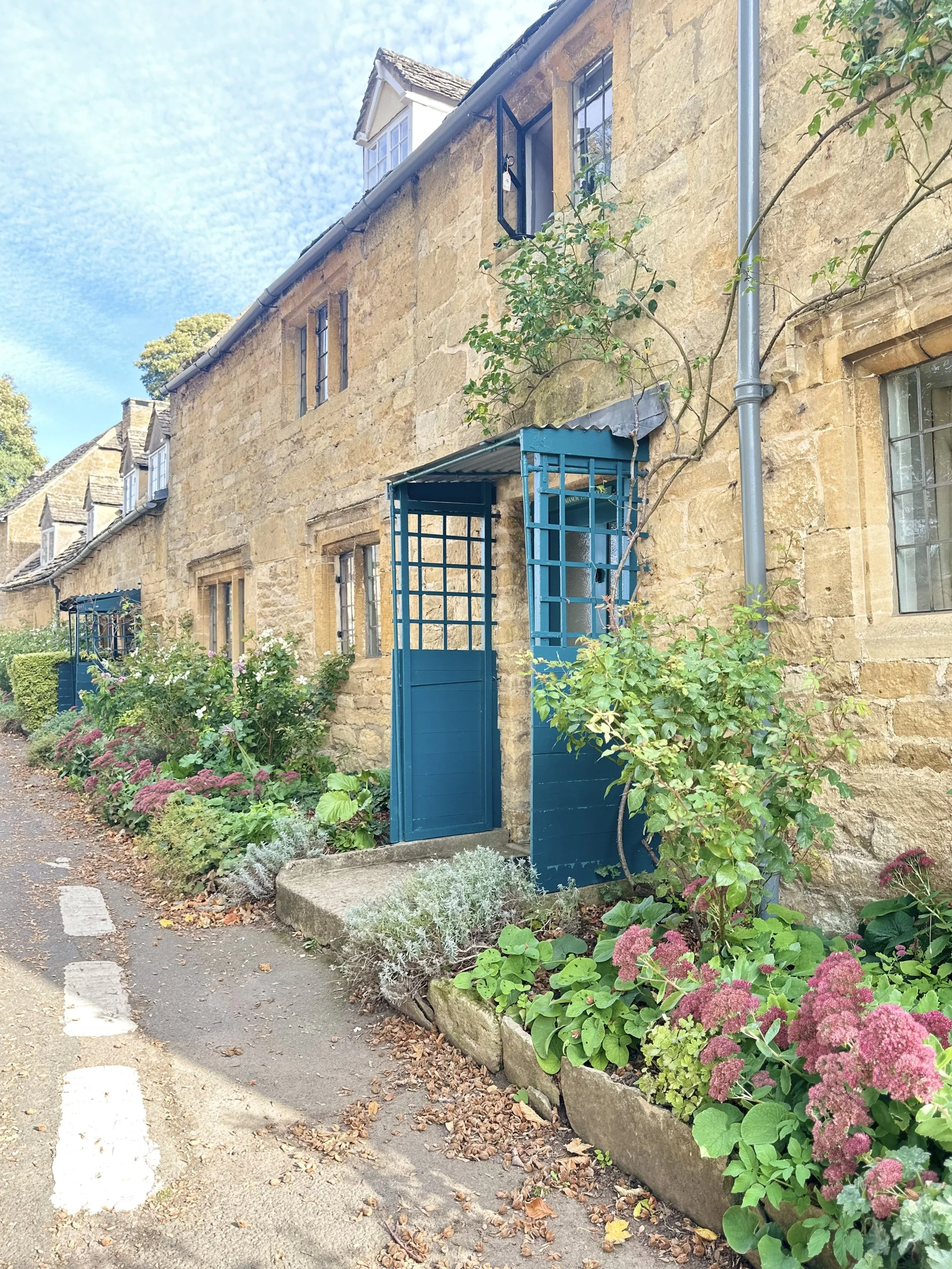
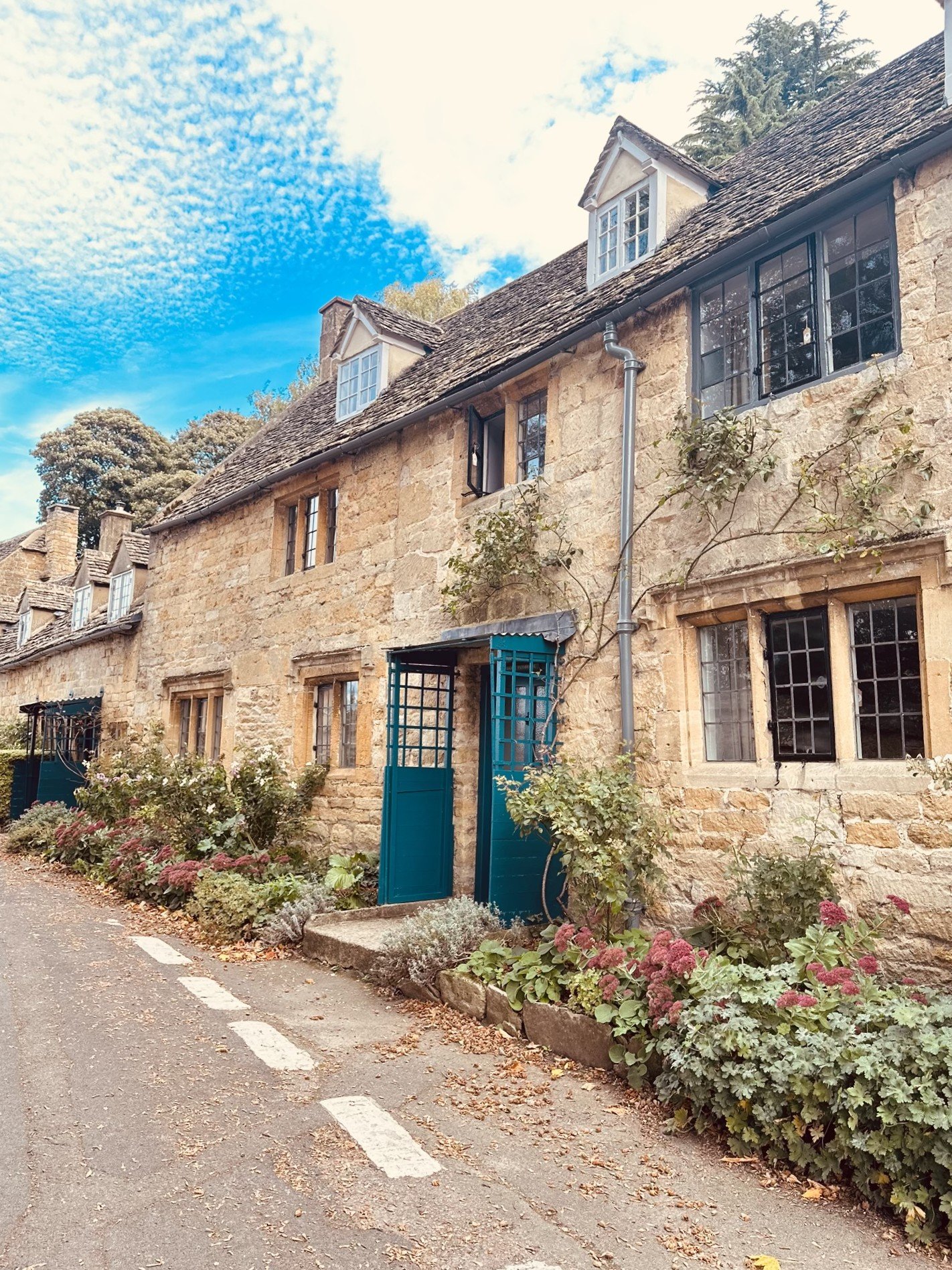
In Broadway, I photographed this row of cottages with teal porch doors. Their roofs are covered in slates cut from Cotswold limestone. The slates are laid with the smallest at the top and the largest at the bottom, on steeply pitched roofs that shed the rain. The windows are small, set in stone frames with leaded panes, and pink sedum was still blooming along the walls in October.
The teal of these porch doors really stood out to me against the old honey-colored stone, and I wondered whether that color even existed when the cottages were built. Blue-green paints existed centuries ago, made from pigments such as verdigris, derived from copper, and Prussian blue, first made in the early 1700s. But those paints were costly, and the bright, even teal on these doors is most likely a modern paint.
The Dry Stone Walls of the Cotswolds
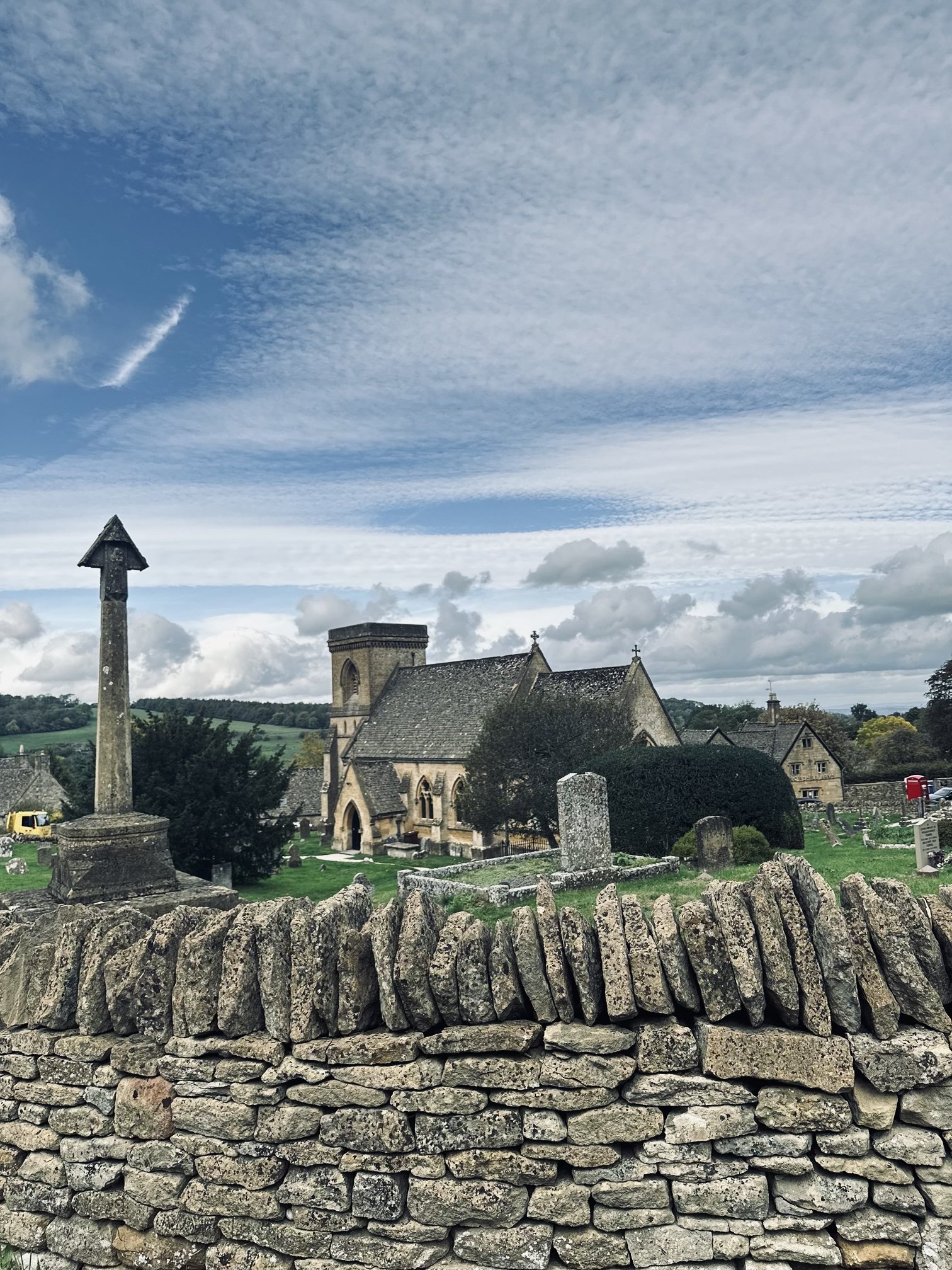
The walls that line the roads and churchyards are built with no mortar at all. Each stone is fitted and stacked by hand. There are about 4,000 miles of these walls across the Cotswolds. Most of the ones standing today were built in the 18th and 19th centuries, though the oldest known dry stone walling in the region dates back to Neolithic times, at Belas Knap near Winchcombe. Mosses, lichens and stonecrop grow in the walls, and you can see the lichen spotting the stone in my photographs.
St Barnabas Church in Snowshill
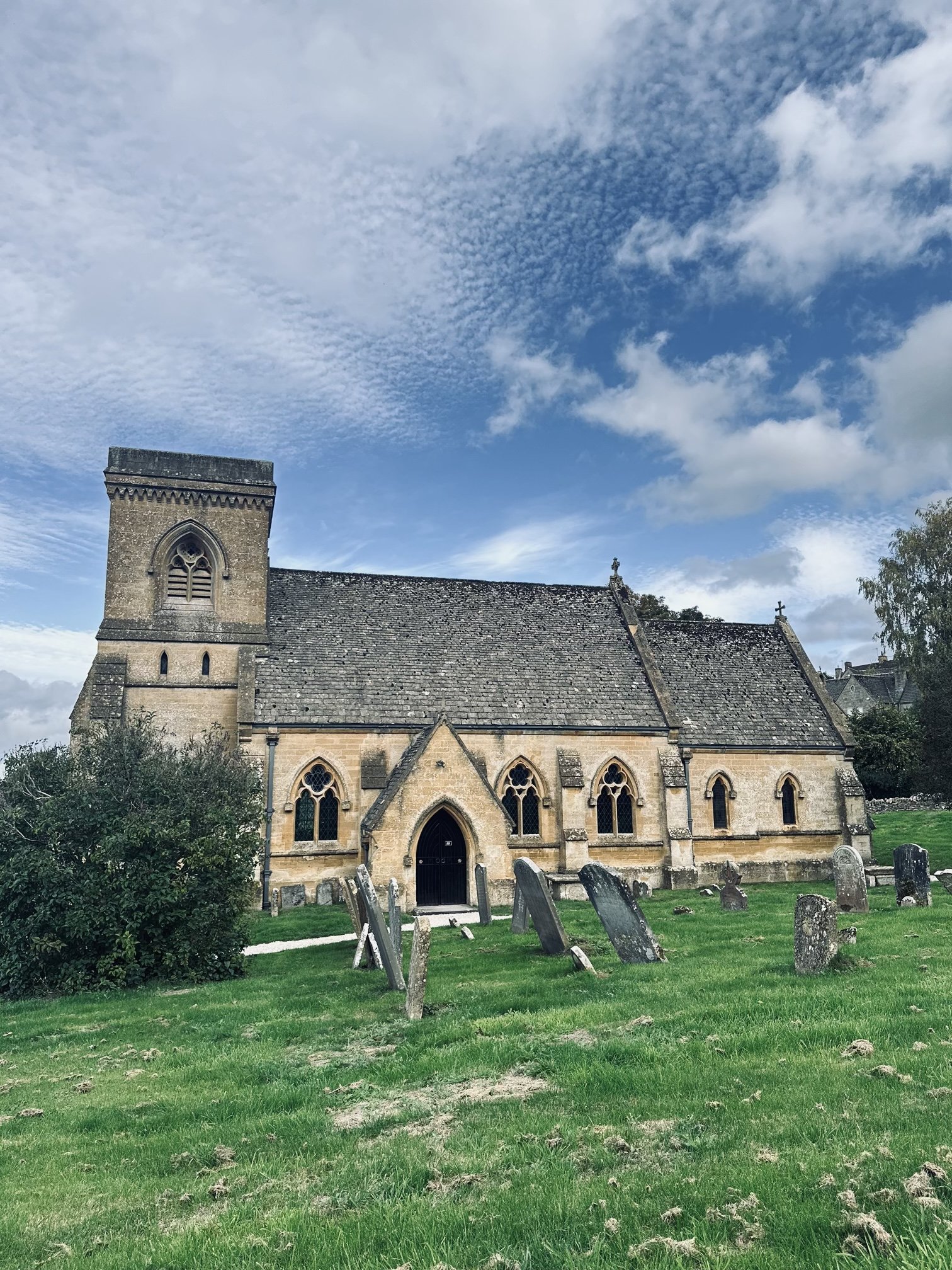
In Snowshill, a small village near Broadway, I came to the church of St Barnabas. The church that stands there now was built in 1864, replacing an older church on the same site. It is made of the same Cotswold stone as the cottages around it and roofed with stone slates. I photographed it from beyond the dry stone wall and from inside the churchyard.
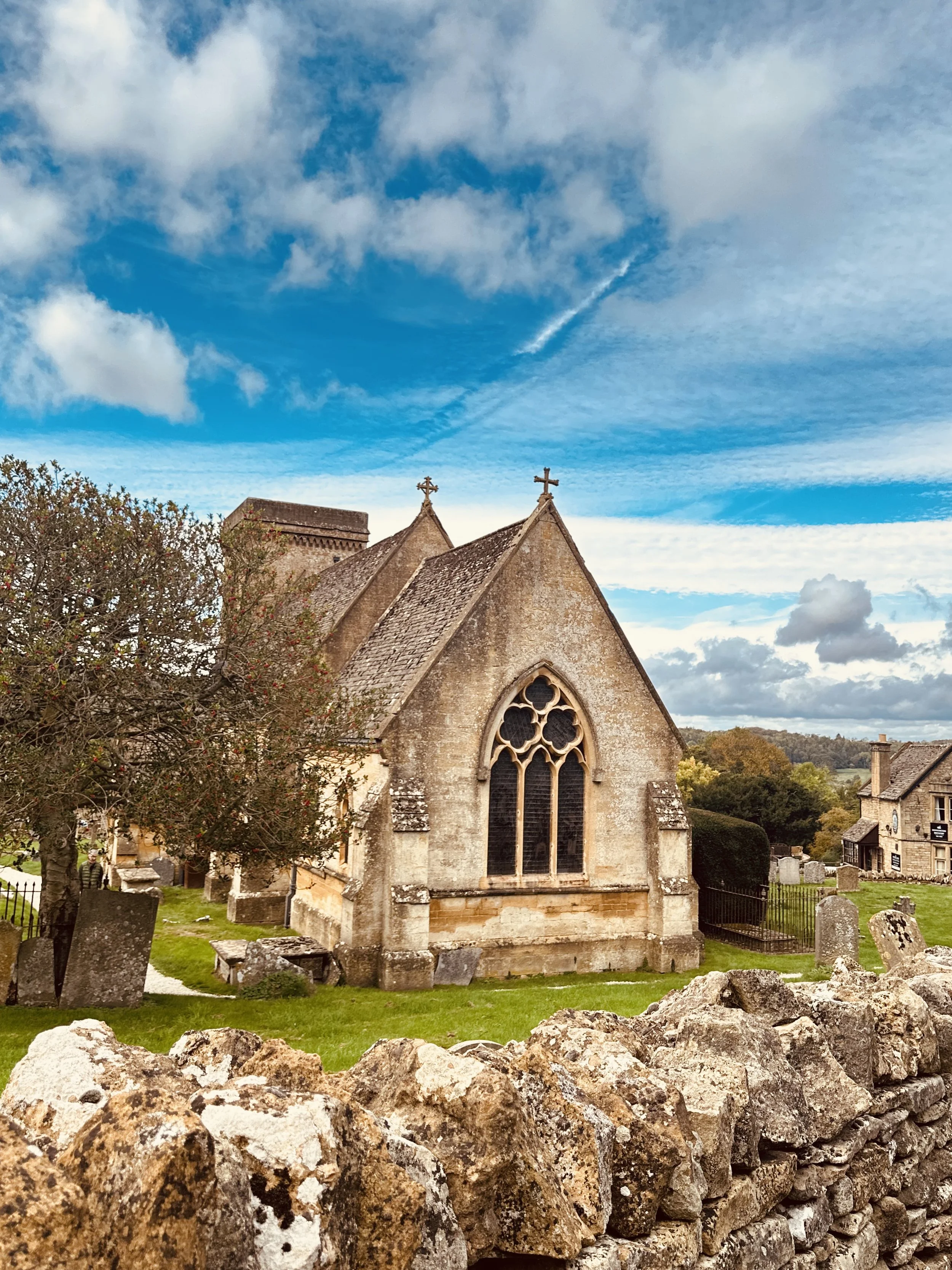
The windows are what drew my eye. Along the side of the church, each window is divided into two pointed openings, each topped with a three-lobed curve, called a trefoil, and crowned by a four-lobed opening, called a quatrefoil, all carved in stone. At the east end of the church, a larger window spreads the same idea across three tall openings, with three-lobed stone openings filling the point of the arch above them. The stonework that divides the glass into these shapes is called tracery, and it is part of what gives the church its Gothic look, even though it was built in the Victorian era.
Snowshill: A Bridget Jones’s Diary Filming Location
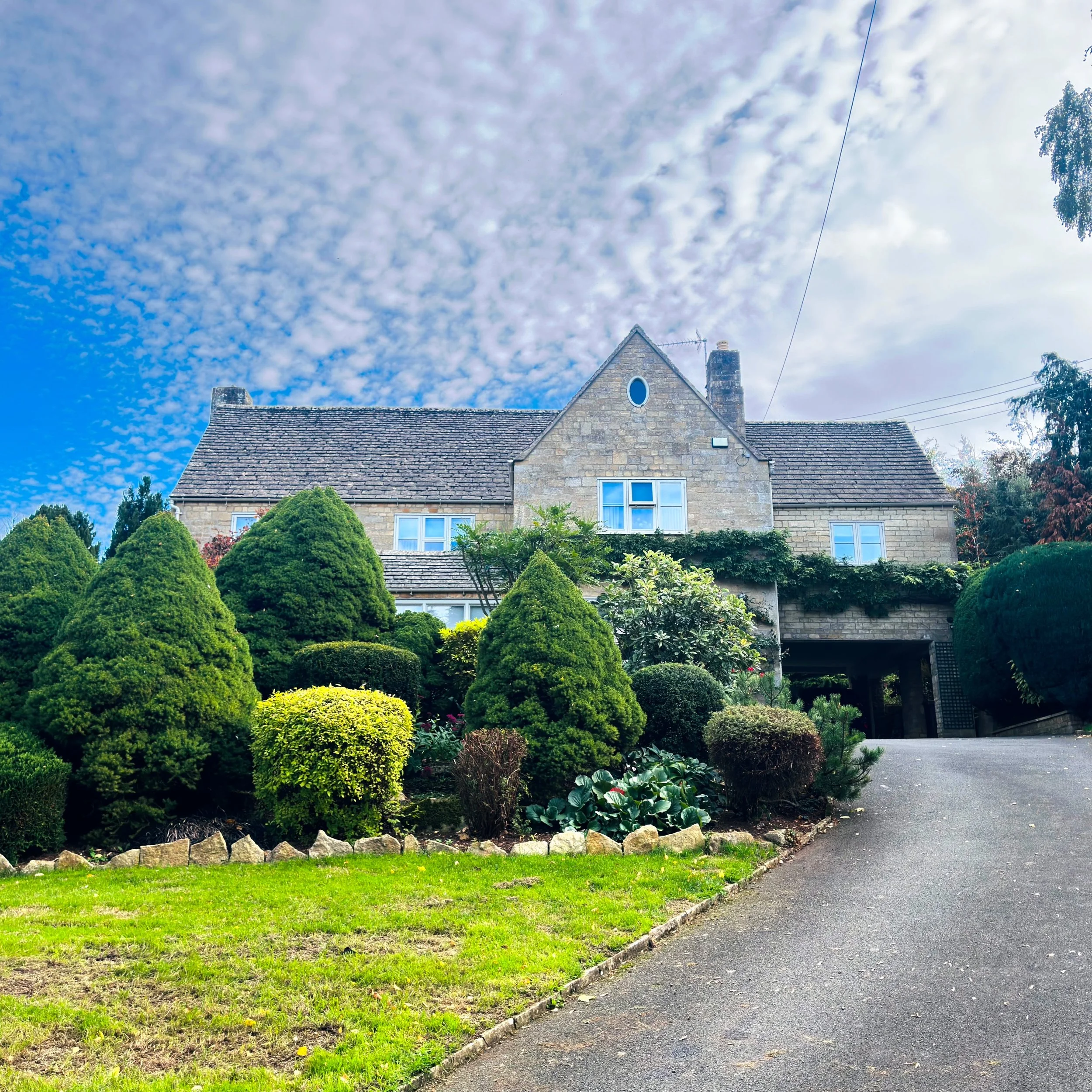
If Snowshill looks familiar, you may have seen it in Bridget Jones’s Diary. The village was used as the home of Bridget’s parents, where the famous turkey curry buffet takes place. In the film, Bridget’s taxi drives past this same church. The scenes were filmed in July, so the crew dressed the summer village in artificial snow and holiday lights to make it look like winter.
Snowshill’s Red Telephone Box
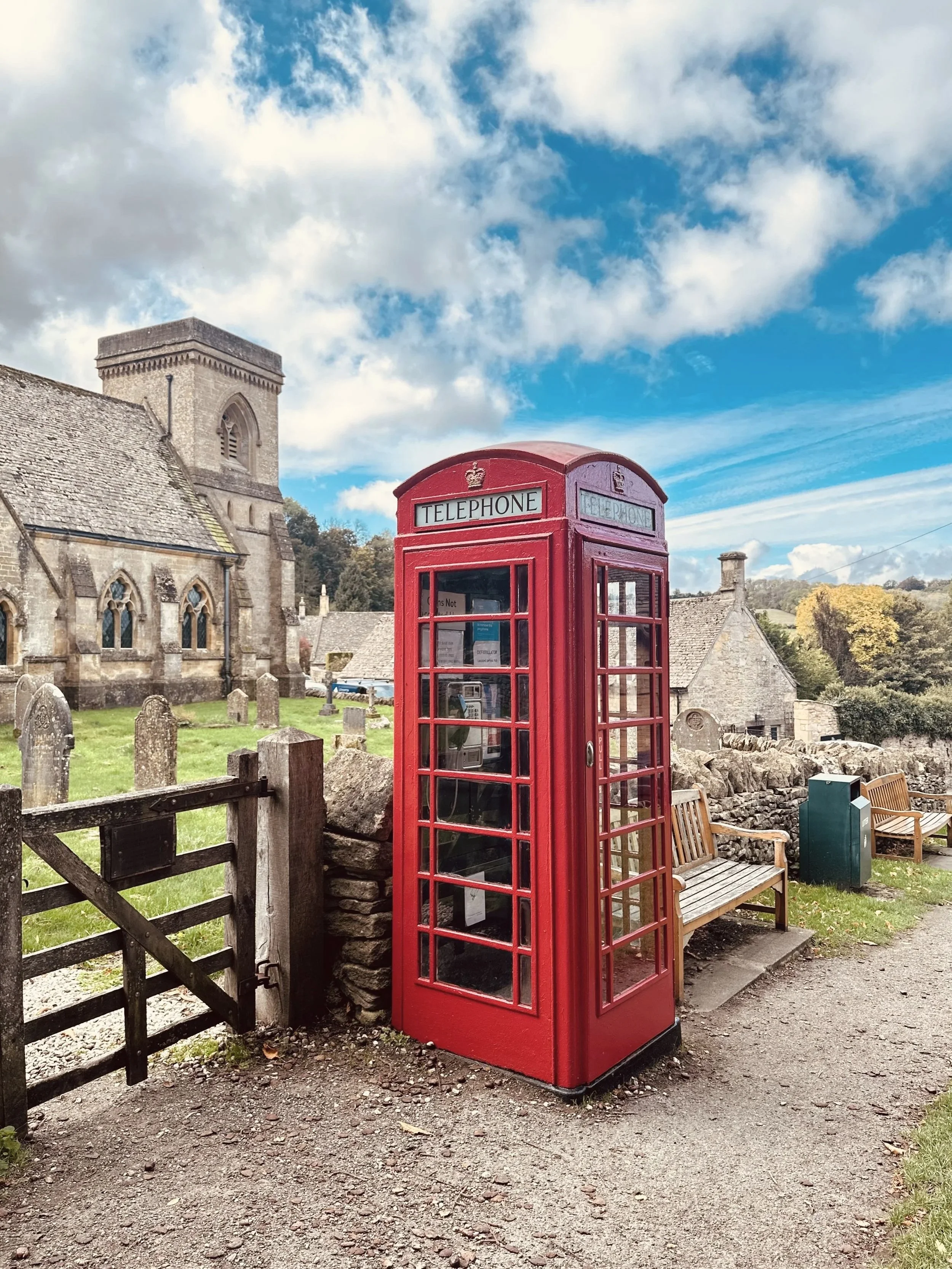
Beside the churchyard gate stands a red telephone box, and this photograph speaks to my love of architecture and art. The colors contradict each other: the telephone box is a bright, glossy red, while the church behind it is weathered stone, grey with lichen. Their form and function are just as different. The telephone box is a small cast-iron kiosk with a domed roof, made for a quick call. The church has steep stone gables, pointed windows and carved tracery, built for worship and meant to last for generations. Seeing them side by side is what made me stop and take the picture.
The telephone box is a design known as the K6, created by the architect Sir Giles Gilbert Scott in 1935 to mark the Silver Jubilee of King George V. As fewer people used public phones, many English villages adopted their boxes for a single pound and kept them standing.
Wool Shops and the Cotswolds’ Wool History
I visited shops that sold the local wool. The Cotswolds grew wealthy on wool in the Middle Ages, and Chipping Campden was one of the old wool towns. Their wealth built many of the great churches in the region, which are still known as wool churches. The cloth trade moved away from the villages centuries ago, and the great cloth mills of the Cotswolds have almost all closed, some as recently as the year 2000. Even the Cotswold sheep, whose wool was once prized by weavers across Europe, is now a rare breed. The small shops still selling local wool, like the ones I visited, are part of what remains of the Cotswold wool trade.
Exploring Cheltenham on My Own
After going through the little shops in each of the Cotswold towns, I took some time to explore Cheltenham. I wandered through the town and stopped for lunch at a local deli. There were no seats left, but a woman sitting by the bay window invited me to join her. I absolutely joined her, and we had a wonderful conversation about travel, about meandering through England, and about other places she recommended I visit. The people were just so gracious and kind.
Design with the Heart™
À bientôt,
Mary

