
My Mother's Chicken Stew with Dumplings (Fricot au Poulet)
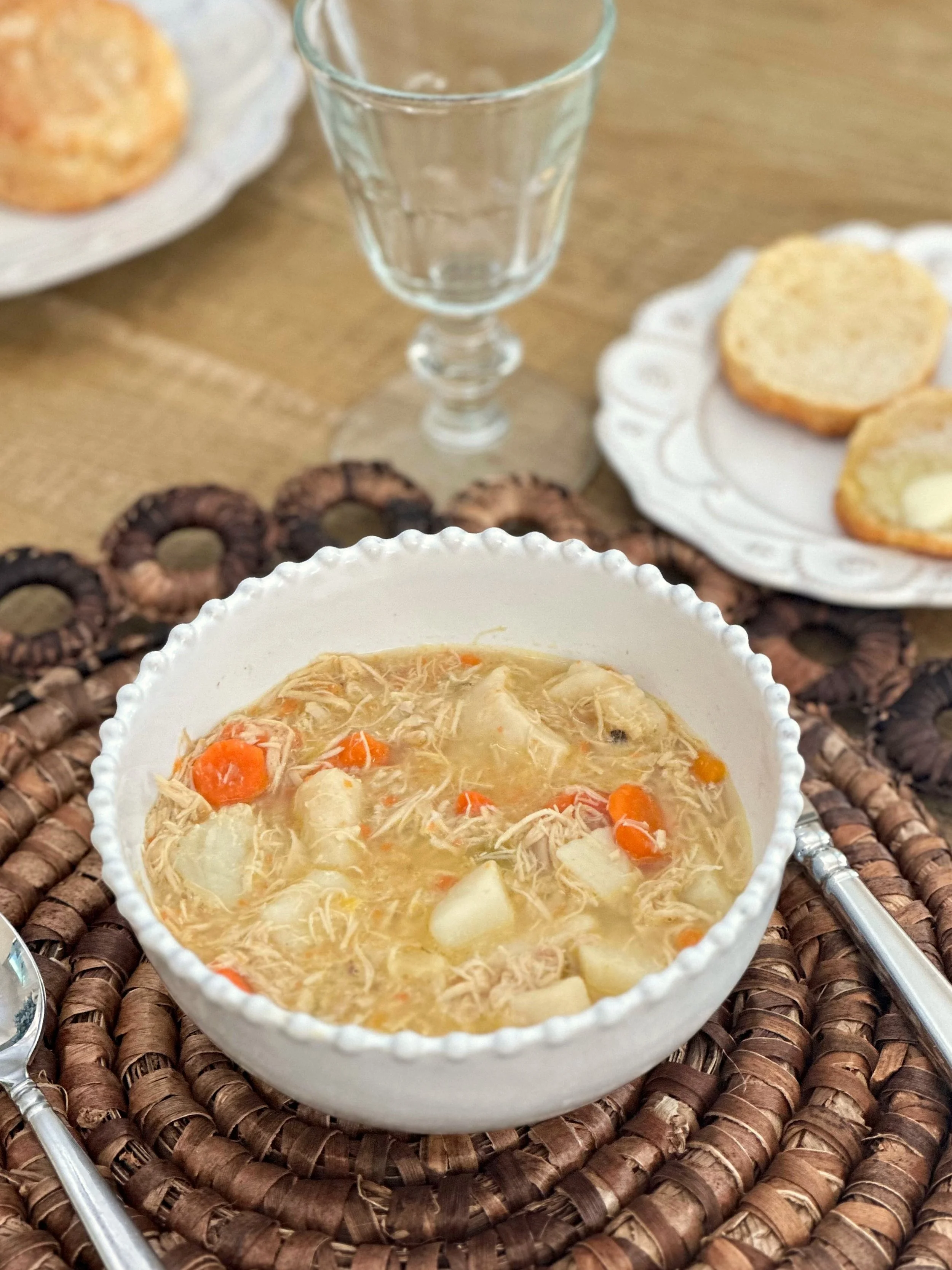
Chicken stew was a favorite we all appreciated, and my mother would make it in the fall and winter, usually on a Saturday, since it took a bit of time. She always had homemade bread and some butter ready to go with it.
She would also serve ployes with it. Ployes are a buckwheat pancake from eastern Canada, cooked very thin, much like the buckwheat galettes you see in Brittany. All you do is put butter on them.
My mother never worked from a recipe. She made it from memory, the way her own mother had made it, and it was handed down from generation to generation that way. All of my aunts made it as well, so it became a staple in every one of our families.
I have made it many times over the years. Like my mother's, mine has pepper in it and is a tinge spicy because of it. And I add thyme, which I love because it pairs so well with chicken and with stews. I also love to serve my old-fashioned biscuits with it, and that has become the tradition in my home.
I wanted to write down this recipe for my daughter and for the others who have asked me for it.
What Fricot Is
In eastern Canada, this kind of stew is known as fricot, a chicken simmered for its broth and finished with potatoes, vegetables, and dumplings. It was such a staple in Acadian homes that "Au fricot!" became the call to come to dinner. Many cooks season it with summer savory, while I use thyme.
As I wrote in Where Women Return, I cook to show love, just as my mother did, and this stew is a good example of that.
The Recipe
I recommend that you read the whole recipe before starting.
Serves 6-8
For the stock
1 whole organic chicken
2 large bay leaves or 3 small
2 garlic cloves
1 carrot
½ onion
2 large celery stalks, cut in half
Water, enough to just cover the chicken
The stock vegetables can be roughly cut, since they are strained out and discarded once the broth is done.
For the stew
1 to 2 tablespoons olive oil
1 small Valencia onion, diced
6 medium celery stalks, cut into bite-sized pieces
4 large garlic cloves, minced
4 medium carrots, cut into bite-sized pieces
2 large potatoes, peeled and cut into bite-sized pieces
The homemade stock you set aside
1 (16 oz) box low-sodium chicken stock
1½ teaspoons dried thyme, plus ½ teaspoon more to taste
1 teaspoon dried rosemary
About 1 teaspoon Penzeys toasted minced onions
1 heaping tablespoon Better Than Bouillon Roasted Chicken Base, Reduced Sodium, if needed
Salt and freshly ground pepper, to taste
For the dumplings
2 cups flour
½ teaspoon salt
1 tablespoon olive oil
¾ cup water
About ½ cup more flour for your work surface
Make the stock
Place the whole chicken in a large pot with the bay leaves, garlic, carrot, onion, and celery, and add water to just cover the chicken.
Bring it to a boil, then reduce it to a low simmer with the lid on for about 60 to 90 minutes, depending on the size of the chicken. Do not overcook it. It is ready when the meat starts to come off the bone, and the chicken is cooked through.
Take the chicken out, and once it is cool enough to handle, take the meat off the bone and refrigerate it.
Strain the broth through a fine-mesh strainer and discard the vegetables and bay leaves. After the long simmer, it is not unusual for small bones to settle at the bottom of the pot, so you want to be sure you catch every one. Honestly, I strain it twice, just to be sure. This is your chicken stock. Set it aside while you sauté the vegetables.
For a fat-free broth, refrigerate the strained broth overnight. When you take it out, you will see that the fat from the chicken has risen to the surface and turned yellow, so skim it off. If you simmer a whole chicken, the broth beneath will thicken with collagen from the bones, a sign of a rich broth.
Make the stew
In a clean pot, warm the olive oil and cook the onion and celery until the onion is translucent, then add the garlic and cook until fragrant.
Add your homemade stock and the 16-ounce box of low-sodium chicken stock.
Add the carrots first and then the potatoes about 1/2 hour later, and simmer until they are almost cooked. I add the carrots first because they take a little longer to cook, and I don’t want the potatoes to get overcooked.
Add the chicken in bite-sized pieces, along with the thyme, rosemary, and Penzeys toasted minced onions, which add more depth of flavor to the stew.
Taste the stew. Every chicken is different, and sometimes the stock lacks the depth of flavor you are looking for. If it needs more, stir in Low Salt Better Than Bouillon.
Season with freshly ground pepper and salt if needed, and add the extra ½ teaspoon of thyme if you would like more.
Make the dumplings
In a bowl, mix the flour, salt, and olive oil. Add the water gradually until the flour is incorporated. The dough may be a bit sticky.
Put about ½ cup of flour on your work surface and start mixing it into the dough until it is no longer sticky to the touch. Knead it until it is a bit elastic.
There are two ways to make the dumplings:
Rolled: Roll the dough out until it is about ⅛ inch thick. Keep it thin, because the dumplings really puff up as they cook, and you will be surprised. Cut the dough into pieces about 1 inch square, give or take. I don't make a science of it; I just cut them with a large knife.
Dropped: Holding the dough in your hand, pinch off small pieces and drop them into the lightly simmering stew. They will really puff up, so don't make them too big.
With the stew at a simmer, drop in the dumplings and cover the pot. They will float to the top at first and grow as they cook. Cook them for about 10 to 15 minutes, until they are cooked through, and cut one open to check that the center is not doughy. Once cooked, they blend right into the stew.
This is where it gets a bit scientific for me, as a person cooking without a recipe. I taste the soup and determine whether it needs more flavor richness. If it does, I will generally add 1/2 teaspoon at a time of dried, granulated roasted garlic and onion from Penzey’s (you don’t need to use Penzey’s, it is just my preferred spice company). It really depends on how rich the stock is. Adding the dumplings will also give this stew a different texture, and the flour on them will thicken it further. You do want this stew to have a thickened consistency.
My old-fashioned biscuits, the ones I serve with this stew, are in my free Autumn Design Guide.
A SHORTCUT TO MAKING THE STEW
Simmering a whole chicken takes time, so when I want this stew sooner, I use boneless chicken and boxed stock instead.
Place 3 good-sized halves of chicken breast in a large pot with the same stock vegetables and bay leaves you would use for the whole chicken.
Add two 32-ounce boxes plus 1/2 of a 32-ounce box of chicken stock, and simmer for about 30 minutes, until the chicken is cooked through.
Remove the chicken, strain the broth, and once it is cool enough to handle, cut it into bite-sized pieces.
Follow the rest of the recipe from step 5. Chicken breasts do not give you the flavor of a whole chicken because you lose the collagen from the bones and the dark meat's flavor, which has more fat, so I often add more Better Than Bouillon. Taste as you go. At this point, you may also add more chicken stock if it has reduced too much from simmering.
If your family has a dish like this one, passed down for generations without ever being written down, I hope you will write yours down, too.
Design with the Heart™
À bientôt,
Mary

