
Westminster Architecture: The Carved Stone of London’s Landmarks
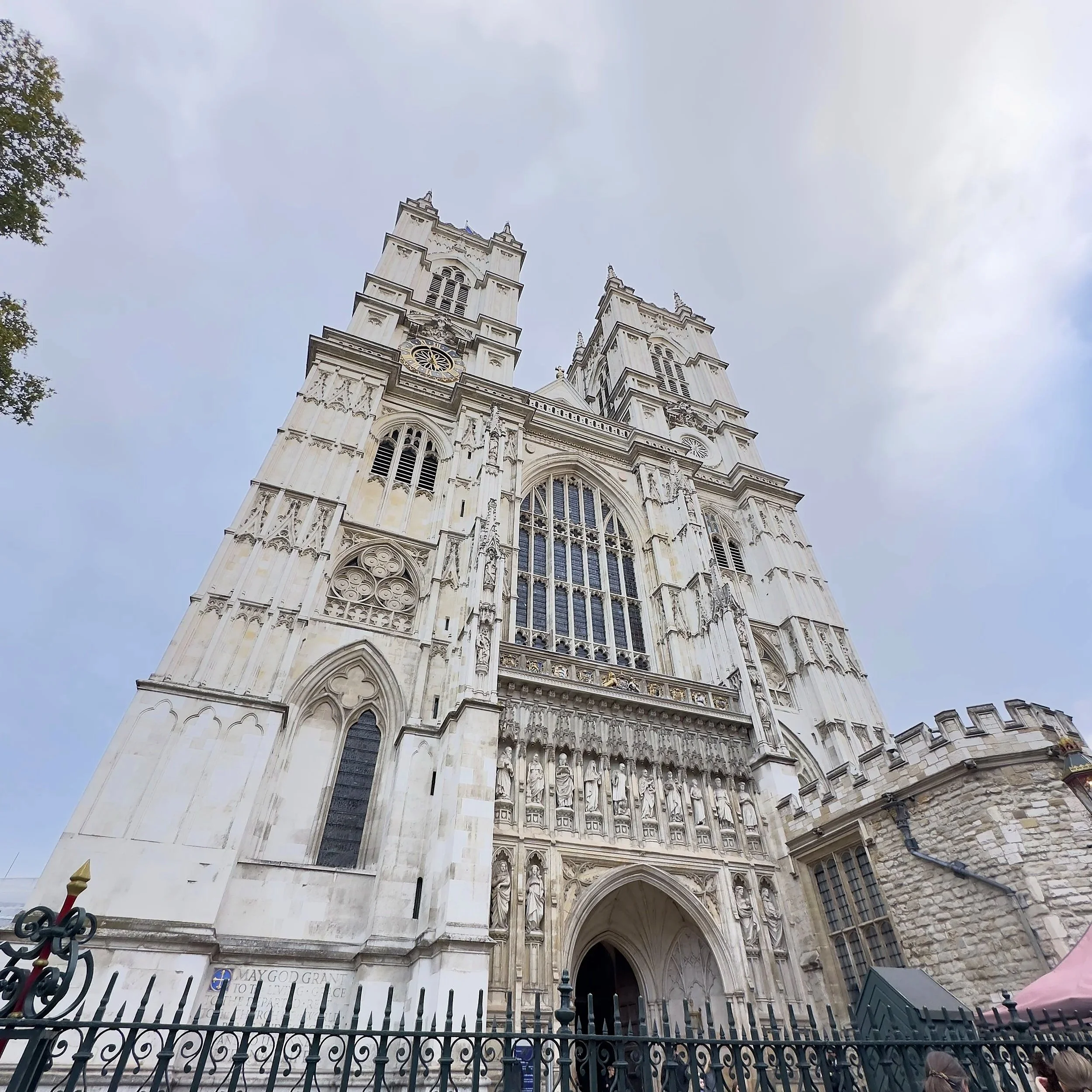
I did not go inside Westminster Abbey on this trip. Instead, I spent my time on the pavement, looking up at the architecture of Westminster.
Within a short walk of one another stand the Abbey, the UK Supreme Court, the Elizabeth Tower that most of us call Big Ben, and the carved government buildings of Whitehall. Their exteriors reward a closer look: saints in their niches, a royal charter cut into stone, gilded Gothic detail, and figures that show how Victorian Britain imagined the wider world. Standing outside, I found that their street-facing walls rewarded as much attention as I might have given the rooms within.
In my last Journal post, The Doors of London, I wrote about color and the welcome a front door offers. This walk is about architecture, and about the stories London’s buildings tell before we ever step inside.
The Buildings on This Westminster Walk
This article looks at the exterior details of four stops, all close to Parliament Square:
The west front of Westminster Abbey
The UK Supreme Court, in the former Middlesex Guildhall
The Elizabeth Tower and the Palace of Westminster
The government buildings along Whitehall
I photographed every one of them from the outside, so this is a walk past their walls rather than an account of their interiors.
Westminster Abbey’s Exterior: The West Front and Towers
The Abbey we see today is largely the work of Henry III, who began rebuilding the church in 1245 in the new Gothic manner of thirteenth-century France. His master mason, Henry de Reyns, is thought to have studied the cathedral at Reims, where the kings of France were crowned, and Henry himself had married a Frenchwoman, Eleanor of Provence. My family’s roots are in France, and I like knowing that a church so bound up with English history took its first lessons from France.
The twin towers on the west front look as old as the rest of the church, but they are not. Their lower stages date from the fifteenth century and stood unfinished for generations. Nicholas Hawksmoor designed the upper sections, and his successor, John James, completed them in Portland stone in 1745, nine years after Hawksmoor’s death. Near the top of the north tower, look for the clock with a single hand, made in 1738.
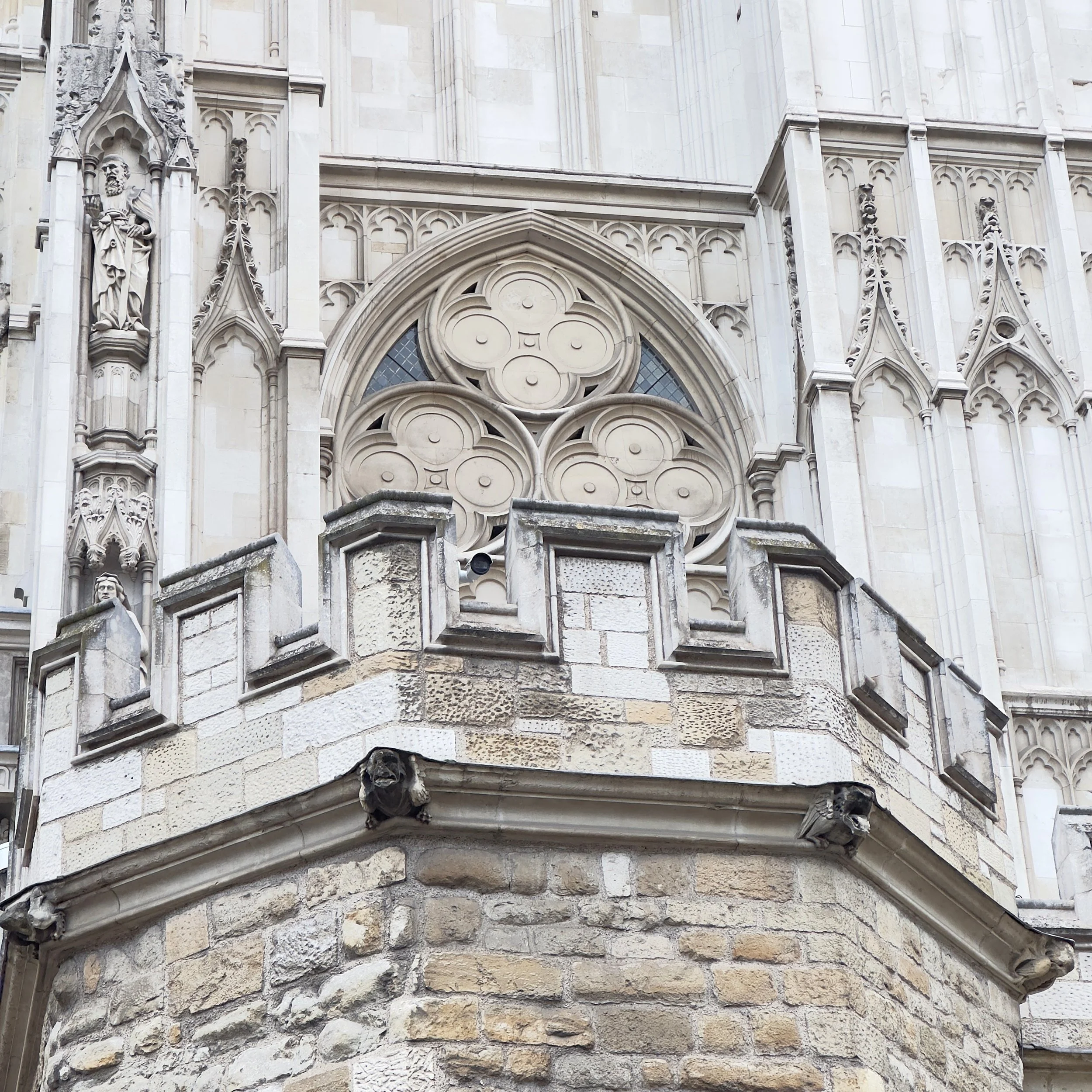
At the base of the south-west tower, a rough, older range of stone with a notched parapet sits against the smooth carved front, and gargoyles lean out from its ledge. Above it, a bearded figure holding a sword stands in a canopied niche. It may well be St Paul: the sword is his traditional emblem, and the Abbey’s records place his statue beside the great west window on this side of the church.
The Ten Martyr Statues Above the West Door
The statues above the Great West Door are the newest carving on the front. The ten niches stood empty for more than two centuries, and in 1998 they were filled with figures of ten Christian martyrs of the twentieth century, who came from many parts of the world, among them Dietrich Bonhoeffer and Archbishop Óscar Romero.
UK Supreme Court: Stone Carvings at Middlesex Guildhall
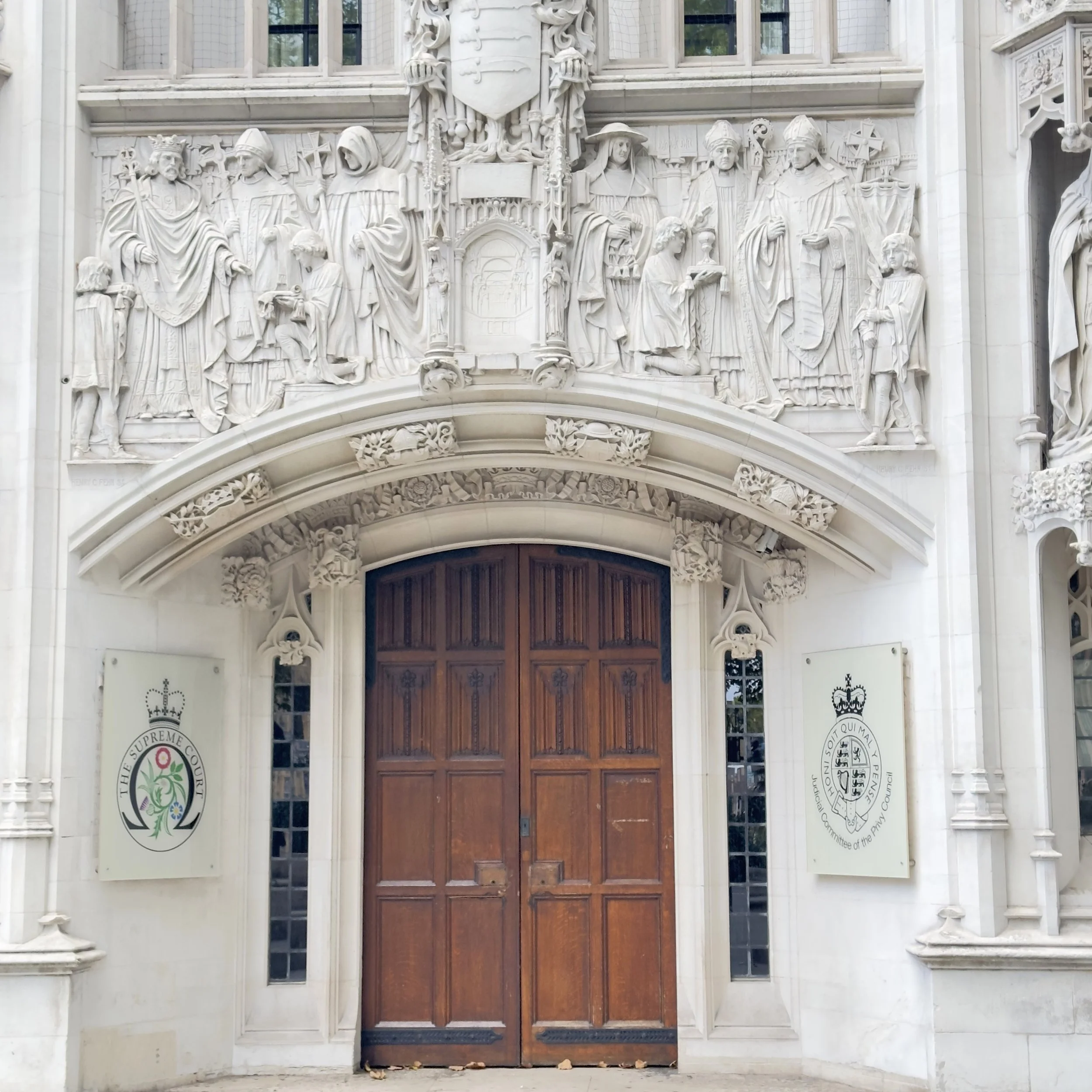
Directly opposite the Abbey stands a building so pale and so heavily carved that it is easy to mistake for part of the Abbey itself. It was built between 1906 and 1913 as the Middlesex Guildhall, designed by the architect James Gibson in Portland stone, and has been home to the Supreme Court of the United Kingdom since 2009. Its sculpture is by Henry Charles Fehr and Carlo Magnoni.
The frieze above the oak doors is the detail I would send any reader to see. It shows Henry III granting a charter to Westminster Abbey, with the Middlesex coat of arms at its center, so the court’s front door carries a carved story about the church across the road. To the left of the entrance, a second frieze shows King John receiving Magna Carta from the barons at Runnymede in 1215. Look closely at the lower edge of the stone, and you will find the signature HENRY C. FEHR cut into it, small enough that most people walk past it.
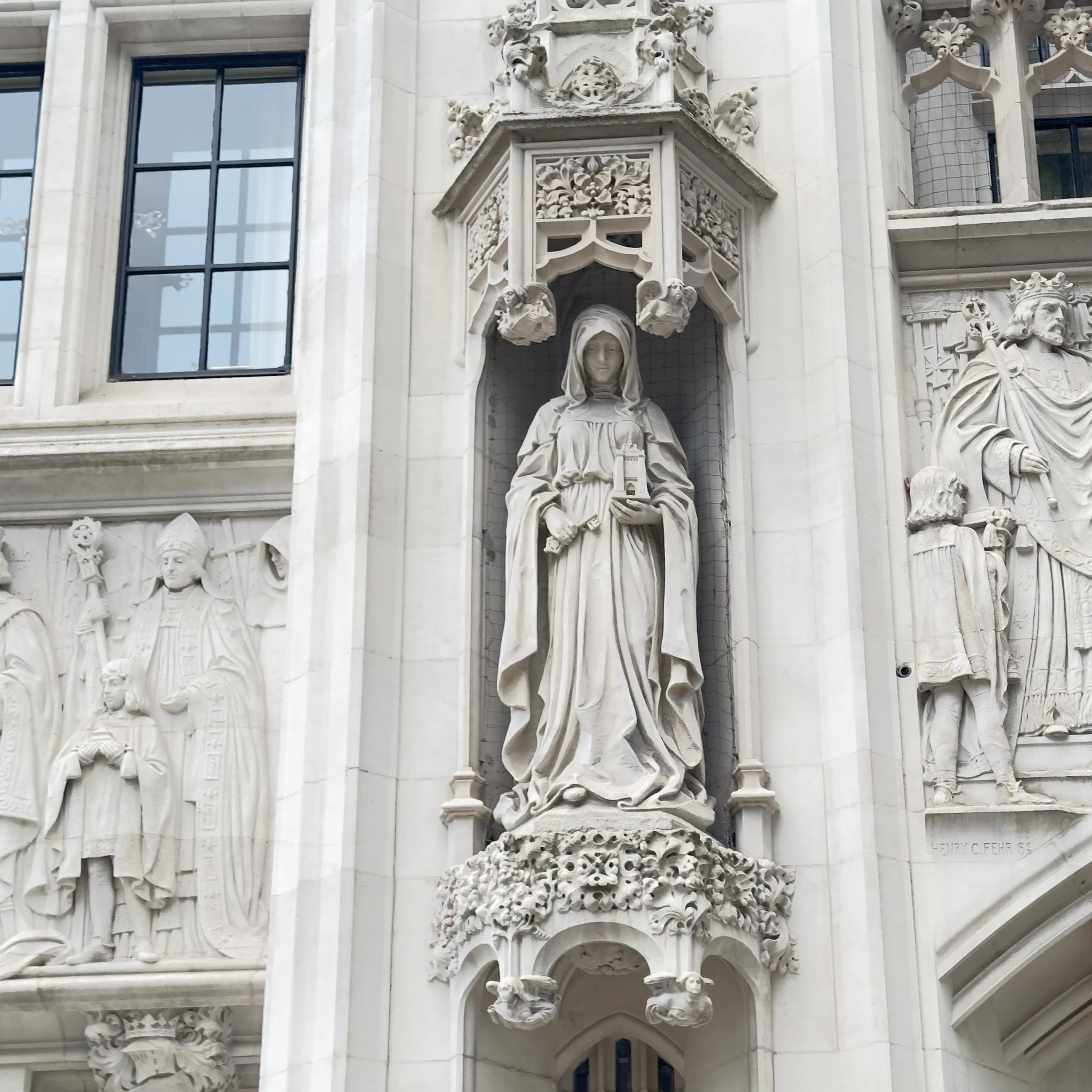
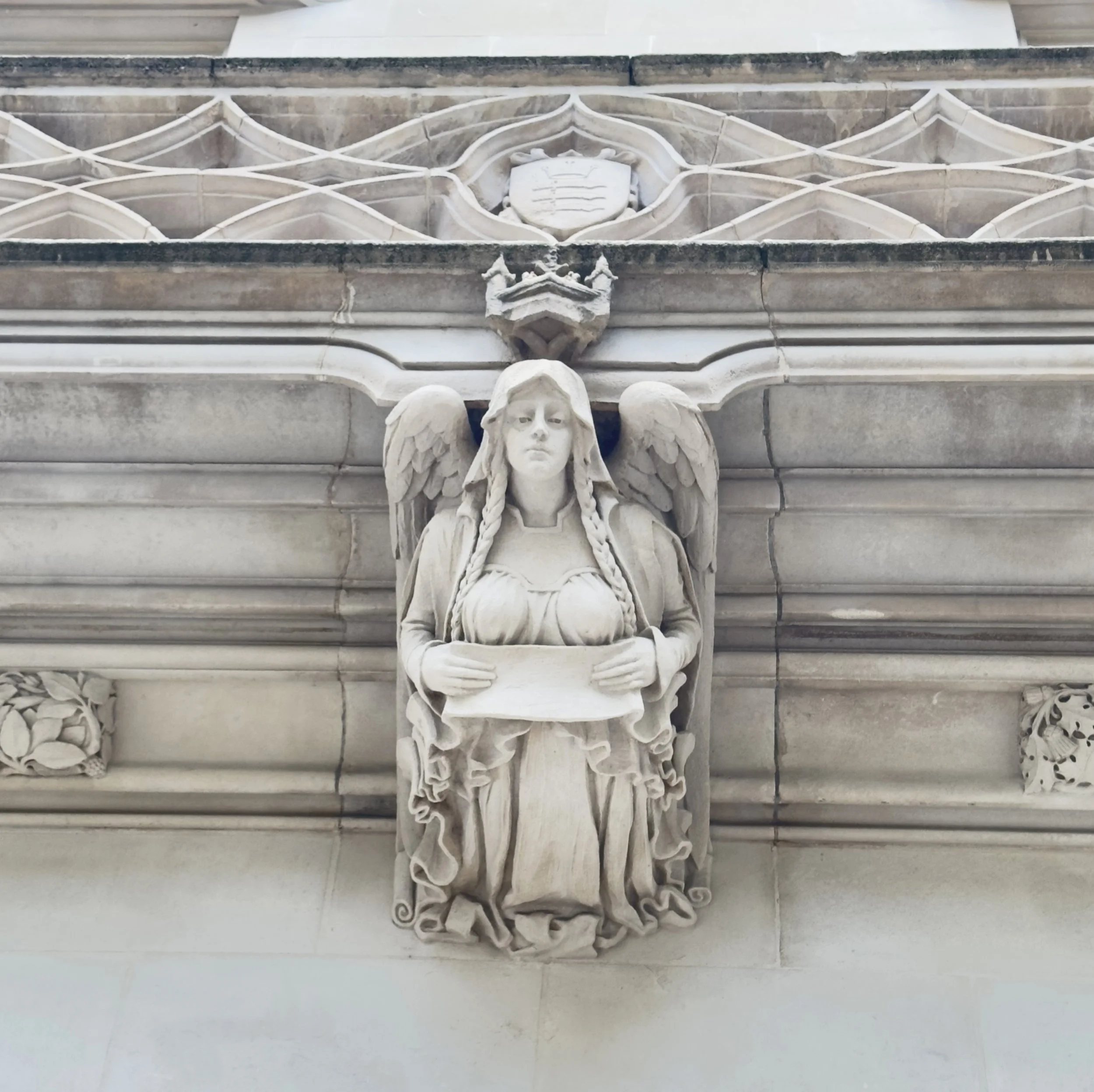
Beside the frieze, a veiled woman stands in a canopied niche, holding a key in one hand and a small building in the other. On the south side of the building, carved angels sit beneath a long balcony, each one a figure in a flowing gown with folded wings and a scroll in her hands, a castle-shaped crown set into the stone above her head. From the pavement, their faces, wings, and scrolls turn the underside of a balcony into something worth stopping to study.
Big Ben Architecture: The Elizabeth Tower
A few steps east, at the north end of the Palace of Westminster, rises the tower the world calls Big Ben. Strictly speaking, Big Ben is the Great Bell inside it. The tower was known simply as the Clock Tower until 2012, when it was renamed the Elizabeth Tower for Queen Elizabeth II’s Diamond Jubilee.
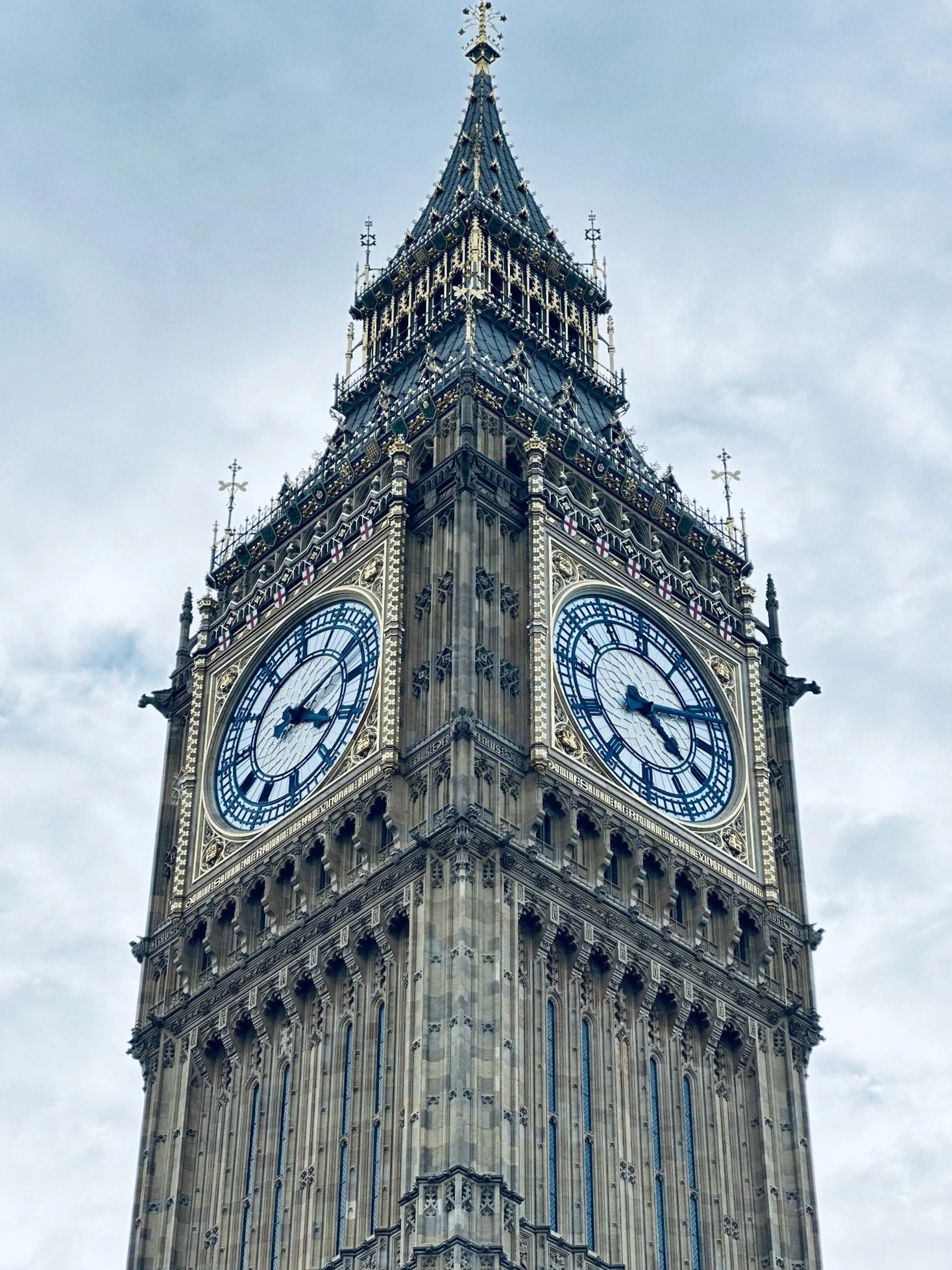
It was built as part of Sir Charles Barry’s new Palace of Westminster, which replaced the medieval palace destroyed by fire in 1834, and was completed in 1859. The design of the tower is Augustus Pugin’s, and it was among the last designs he made before his death in 1852. Seen up close, the tower is carved and gilded all the way up to the clock faces.
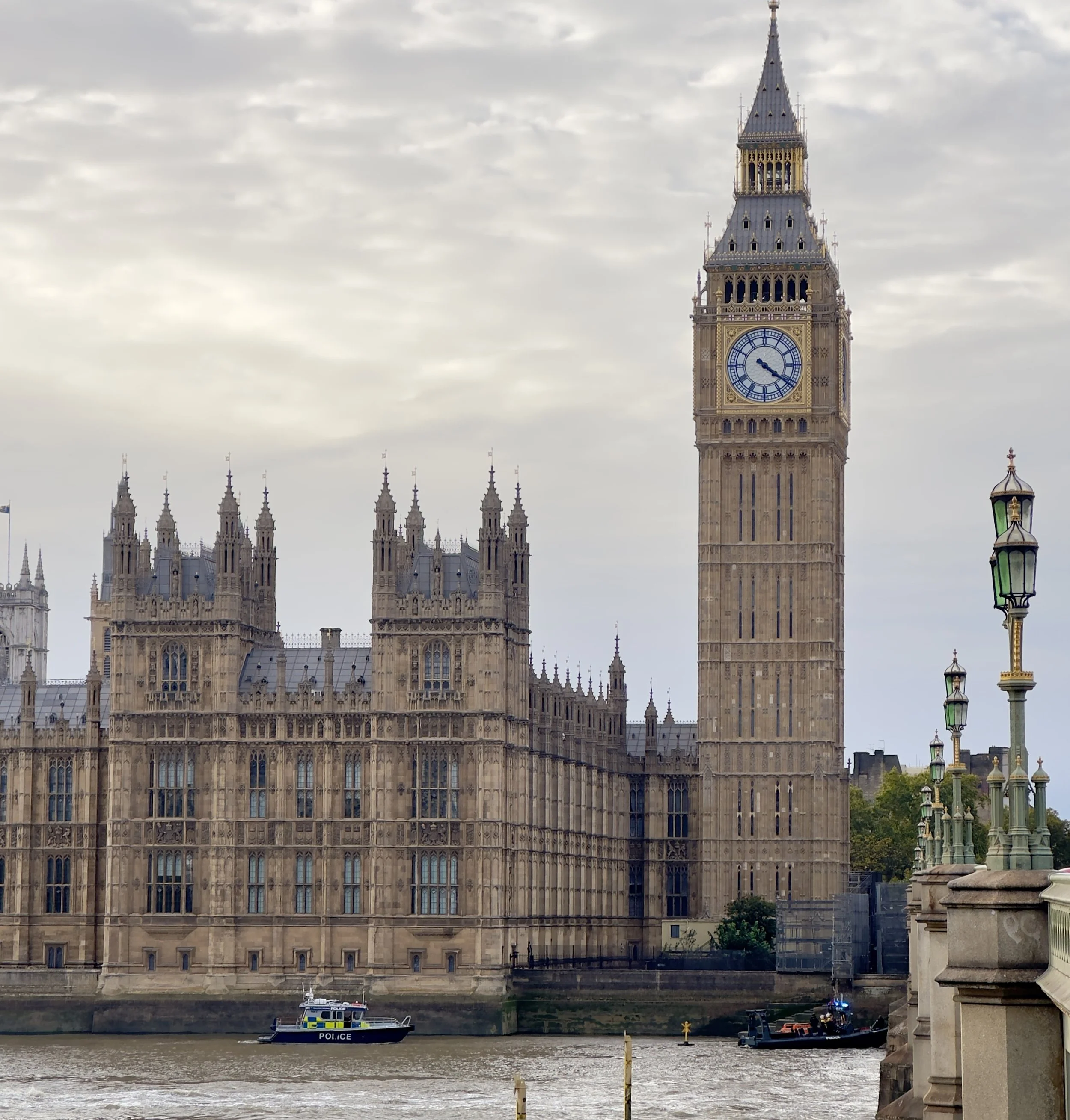
Along the river, the whole palace reads as one long Gothic front, its green lamps lining the embankment wall. From there you can see how this small corner of London fits together: a medieval abbey, a Victorian palace, and an Edwardian courthouse, built centuries apart and all in the Gothic manner.
Whitehall Sculptures: The Figure of America
The last carving on this walk is a short way up Whitehall, on the long government building designed by Sir George Gilbert Scott that now houses the Foreign, Commonwealth and Development Office. Its Whitehall front was completed in the 1870s as the Home and Colonial Offices, and between its lowest windows the sculptor Henry Hugh Armstead carved allegorical figures of the continents.
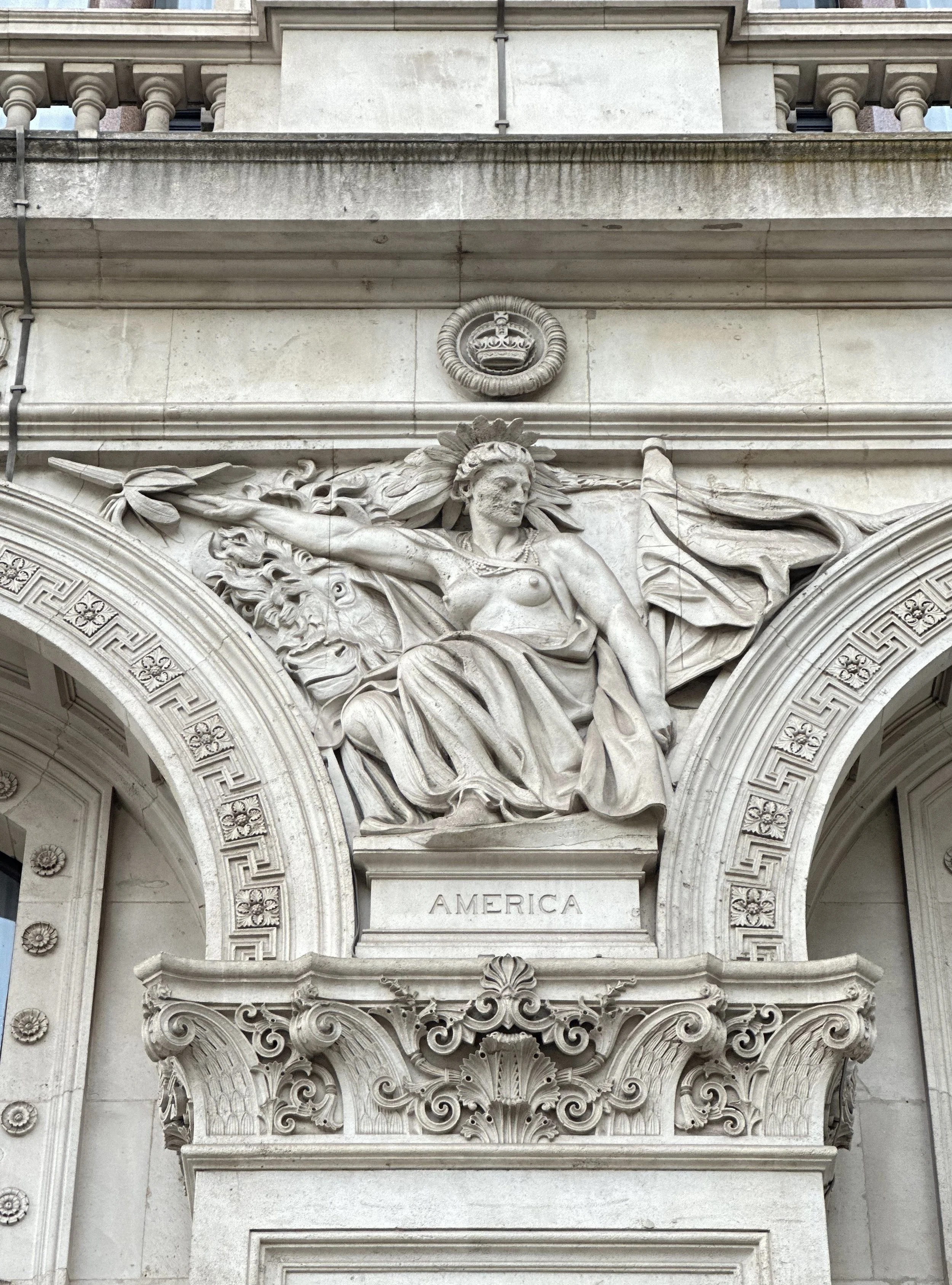
The panel marked AMERICA is the one I photographed. A seated woman in a feathered headdress fills the space between two arches, one arm stretched out, a bison’s head beside her and a flag falling behind her, with the name of her continent cut in capitals on the plinth below and a carved crown set just above. She is an allegory, not a portrait of anyone who lived in America, and for an American reader she is our own continent as a Victorian sculptor imagined it for a British government building. I read her the way I would read an old map, for what she shows about how Britain saw the world in the age of empire.
How Architecture Shapes the Way I Design
Architecture has always influenced the way I design, and much of that education has happened on the road. I studied a great deal of art history in college, but nothing in a lecture hall prepared me for standing in front of these buildings. From the Roman stones of Provence to the Gothic carving of Westminster, I look for the same things wherever I go: the lines a builder chose, the forms those lines create, and the function each detail was meant to serve. These buildings rose centuries apart, made by people from different cultures, and each has taught me something about craft and heritage.
As a little girl growing up in Connecticut, I never dreamed that I would travel to faraway countries, become immersed in cultures other than my own, and come home with friendships from around the world. Travel allows you to see people in ways no textbook can explain, and I am so grateful to have had that experience.
Becoming does not end when the classroom does. The classroom teaches us about other parts of the world, but travel lets us know them through a fully immersive experience of their culture, land, and people. It is a different kind of knowing altogether, one that cannot be read, only lived. So many of us spend years carrying so much for so many that we forget we are still allowed to learn, to wander, and to be changed by what we see. Travel is education, and growth is what it leaves behind: a wider understanding of the world, and of our place within it.
That growth is what I mean by becoming. It is the pursuit of the things we love, the feeding of the curious part of ourselves that the busy years so often set aside, and a deeper understanding of the human spirit, both in the people we meet and in ourselves. It is also why my approach to design is never finished. What I bring home finds its way into the rooms and tables I design, and, above all, into the gatherings, because a gathering is where design and relationships meet. A table can be arranged with great care, but it only comes to life when the people around it bring their own ways of seeing the world, and travel has taught me to welcome every one of them.
If you would like MERZE’s free seasonal Design Guides, you can sign up for them here.
Design with the Heart™
À bientôt, Mary

