A Berries-and-Cream Mille-Feuille for a Summer Gathering
A from-scratch French pastry cream layered with all-butter puff pastry, Connecticut strawberries, and edible garden violas, and why I almost never take the shortcut.
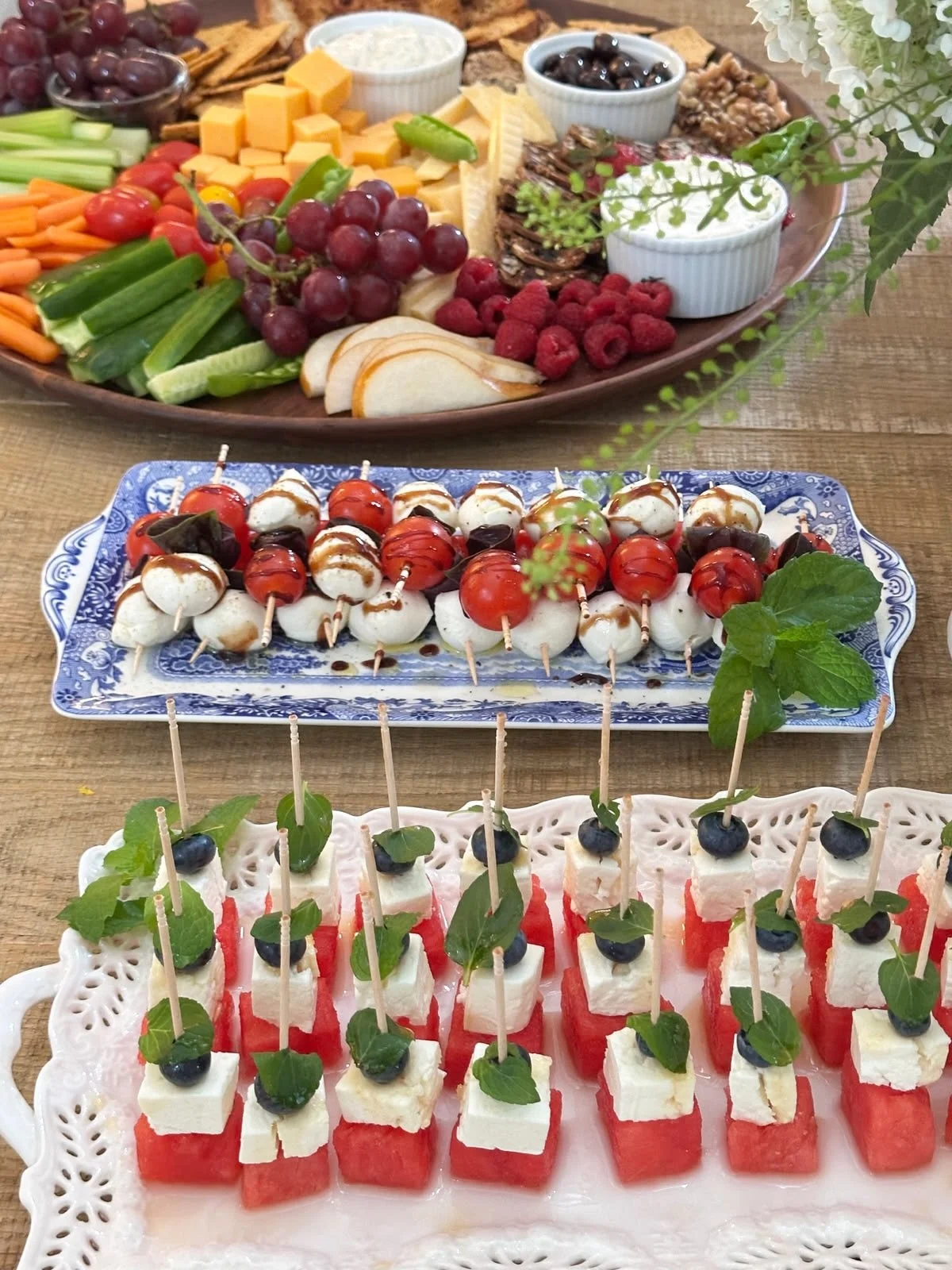
About a week before the Fourth of July, I had a houseful of guests coming for an afternoon at my home. There were appetizers to make, a grazing board to build, a watermelon cocktail to pour, and a table to set. And in the middle of all of it, I decided to make a mille-feuille from scratch, the pastry cream cooked slowly on the stove the day before, the buttercream whipped by hand, the strawberries picked at the height of their season.
There is a faster version of this dessert. You buy the puff pastry, you beat some cream cheese with powdered sugar, you pile on fruit, and you are done in twenty minutes. I know that version. I have seen it. I chose not to make it that day because the cream is the whole reason, and it's the part you cannot rush.
What a Mille-Feuille Actually Is
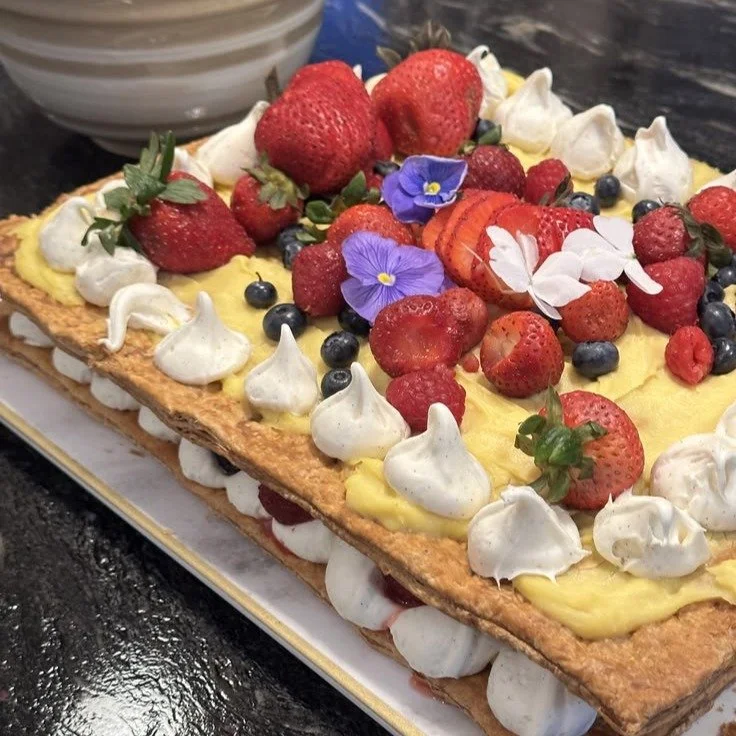
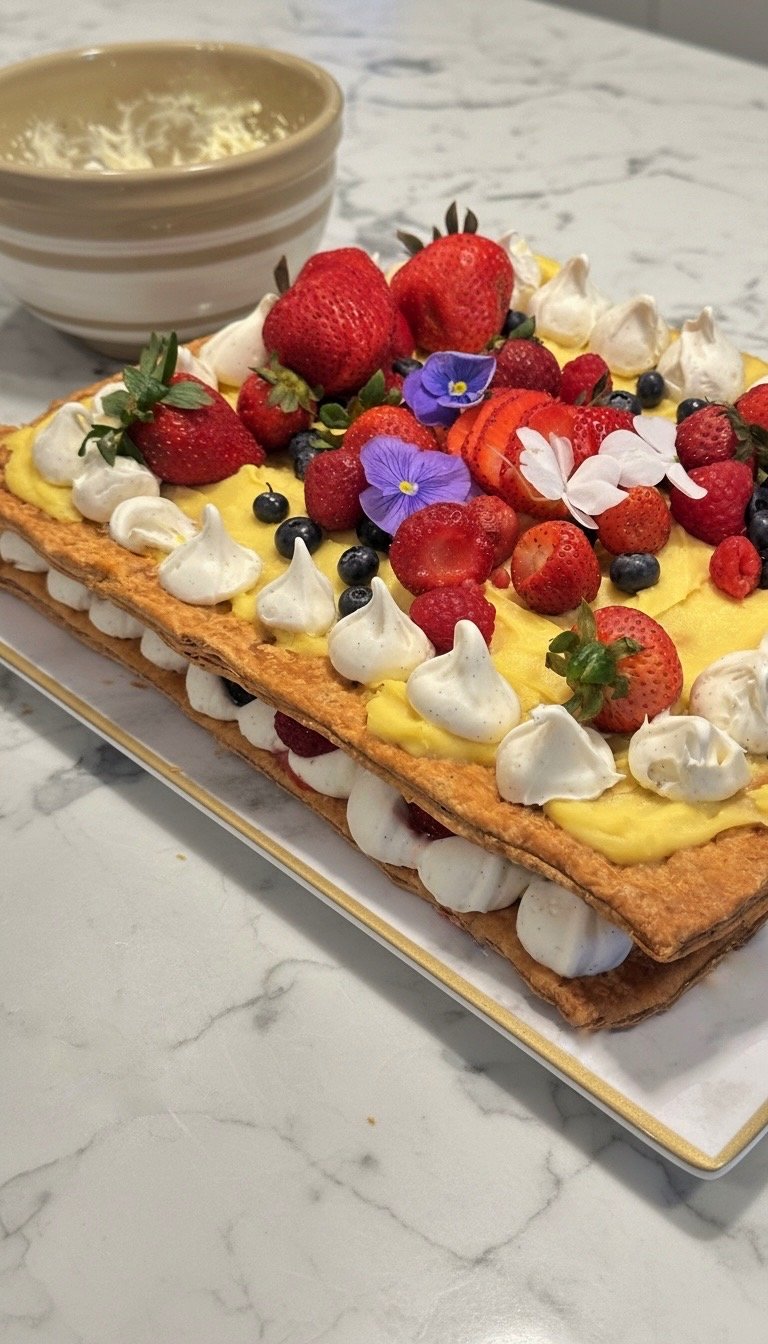
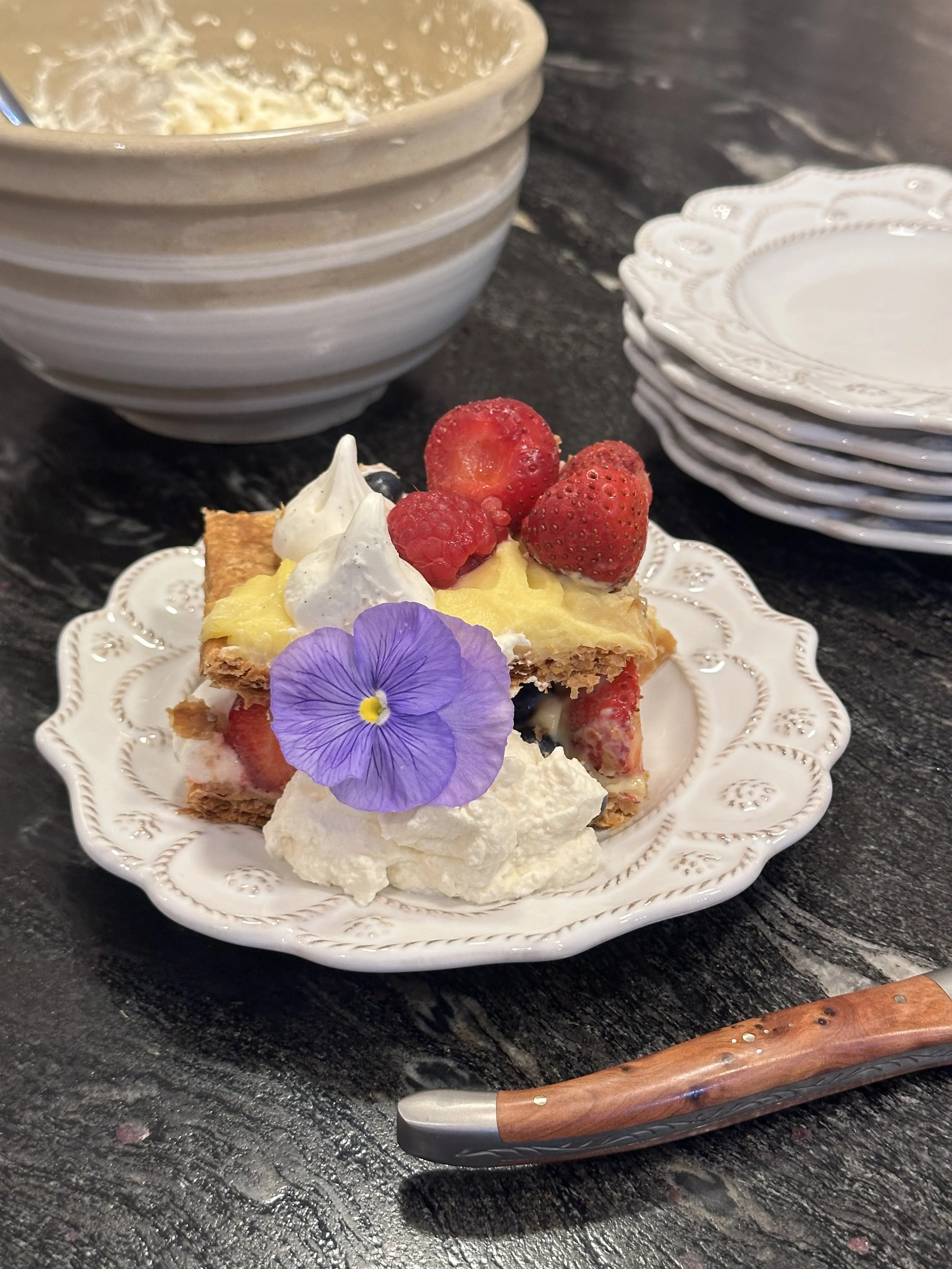
Mille-feuille, pronounced meel-fwee, means a thousand leaves. The name comes from the way puff pastry bakes into hundreds of paper-thin layers that shatter the moment your fork goes through them. In its classic French form, it is several sheets of pastry stacked with pastry cream between them, finished with a glazed or powdered top. The one I made was a little more generous and a little more summer: two golden layers, filled and bordered with cream, then piled high with ripe berries and a few violas from the garden.
It is a dessert that announces itself. When I carried it out to the table, the room went quiet for a second. That is the whole point of making something like this.
The Crème Pâtissière
This is the heart of it. A cream-filled dessert is only ever as good as its cream, and there is nothing you can buy or shortcut that does what a real crème pâtissière does. Cooking egg yolks and whole milk together slowly over heat turns them into something neither one was on its own, silky, rich, and thick enough to hold its shape between the layers without sliding or weeping.
This is the same cream that fills éclairs, fruit tarts, and the best napoleons. It is neither whipped cream nor cream cheese. It is a properly cooked custard, and it is worth every minute.
Crème Pâtissière
This recipe makes enough crème pâtissière to fill one large mille-feuille. (When I made mine for a crowd, I doubled it.)
2 cups whole milk
4 large egg yolks
½ cup granulated sugar
3 tablespoons cornstarch
2 tablespoons cold unsalted butter, cut into small pieces
1½ teaspoons pure vanilla extract
A pinch of fine salt
Warm the milk in a heavy-bottomed saucepan over medium heat until it just starts to steam, when you see small bubbles forming around the edge, not a full boil. While that warms, whisk the egg yolks, sugar, cornstarch, and salt together in a separate bowl until the mixture turns pale and thick. Give it a good two minutes of whisking.
Now pour about half the hot milk into the yolks in a VERY slow, steady stream, whisking the whole time. This step is called tempering, and it gently brings the yolks up to temperature so they warm rather than scramble. Once that is smooth, pour it all back into the saucepan with the rest of the milk.
Set it back over medium heat and whisk without stopping, paying special attention to the bottom and corners of the pan where it likes to catch. Keep going until the cream thickens and begins to bubble, then let it bubble for one more minute. You need to be very patient with this process…it took me about 13 minutes for the mixture to finally thicken. Take it off the heat, whisk in the cold butter a piece at a time until it disappears, and finish with the vanilla.
Scrape it into a clean bowl and press a piece of plastic wrap right down onto the surface so no skin forms. Chill it until it is completely cold, at least two hours, though overnight is even better. The flavor deepens by the next day. When you are ready to use it, whisk it for a moment to bring it back to a smooth, pipeable consistency.
The Vanilla Buttercream Border
The buttercream is not just for looks. Piped in a ring around the edge of each pastry layer, it acts like a little retaining wall, holding the cream and fruit in place so nothing slides off as the dessert chills.
Vanilla Buttercream for piping:
1 cup (2 sticks) unsalted butter, softened
2½ cups powdered sugar, sifted
1½ teaspoons pure vanilla extract
2 to 3 tablespoons heavy cream
A pinch of salt
Beat the butter on medium-high speed until pale and fluffy, about 3 minutes. Add the powdered sugar a little at a time on low speed so it does not fly everywhere, then increase the speed to medium and beat until smooth. Add the vanilla, the salt, and the heavy cream one tablespoon at a time until it is firm enough to hold a peak but soft enough to pipe.
I will be honest with you about mine. It sat out a bit longer than it should have while I was running between the table and the kitchen, and my piped peaks were not as sharp as I wanted. They held anyway. The border did its job, the dessert was beautiful, and no one at my table was measuring my buttercream. A real kitchen is not about perfection. It is about doing the thing with care and letting it be what it is.
If yours softens before you pipe, pop it in the refrigerator for 10 minutes, then beat it briefly again.
The Puff Pastry
I used store-bought all-butter puff pastry, and I will say that without a shred of guilt. Julia Child used store-bought puff pastry. So does nearly every French home cook I admire. Making laminated dough from scratch is a two-day project that demands your full attention, and I was also making three appetizers, a grazing board, a meal, and a cocktail for a house full of people.
Buy the best all-butter puff pastry you can find. Dufour is the one I reach for in American grocery stores, and it bakes up genuinely flaky and full of flavor. Roll it to an even quarter-inch thickness, bake it flat between parchment paper, two sheet pans with a third pan on top, and let it cool completely before it comes anywhere near the cream.
Note: I only had 2 baking pans, so I baked the puffed pastry one at a time. I place parchment paper down on the sheet pan, then layered the puffed pastry, then another layer of parchment paper, then the other sheet pan on top. Stacking them like this allows for the puffed pastry to cook without puffing up too much.
A note on color: score the pastry lightly before baking, but do not cut all the way through, and bake it until it reaches a deep, rich gold. A pale pastry goes soggy the moment the cream touches it. The color is what gives it its backbone.
The Berries and the Violas
Connecticut strawberries in late June are something else entirely, smaller than the grocery-store kind, red all the way to the center, and sweet in the way fruit is only sweet when it has had real time and real soil. I used whole large ones for height on top and the small ones in the middle. Raspberries, blackberries and blueberries went into every gap.
The organically grown violas came from my own garden, cut that morning, purple and white, and set on at the very last moment before the platter went to the table. There is something a flower you grew yourself brings that a store-bought garnish never can. The people who sat down to this dessert felt it, even if they could not have told you exactly what it was.
One tip: place the flowers after the dessert has chilled, never before. The cold and the condensation will wilt them within the hour. Also, be sure any flower you use is both edible and free of pesticides.
Putting It All Together
Bake your two puff pastry rectangles until golden brown, then let them cool completely for at least an hour.
Whisk the cold crème pâtissière until smooth, then spoon it into a piping bag fitted with a large round tip.
Pipe a generous layer of crème pâtissière over the first sheet of pastry.
Pipe the vanilla buttercream in an unbroken border all the way around the edge. This is your wall.
Fill the inside of that border generously with berries, whole strawberries, raspberries, and blueberries.
Set the second pastry layer on top and do it all again: cream, border, berries.
Finish the top with whole strawberries standing upright, more berries tucked in with care, and the violas placed last.
Chill it uncovered for an hour or two before serving. This firms the buttercream and lets everything settle.
Slice with a sharp serrated knife, wiping the blade clean between cuts, and serve right away.
A word on timing: you can put it together up to two hours before serving, but resist building it the night before. The pastry softens overnight under the cream and loses the shatter that defines it. The buttercream matters here, too; it needs to be firm enough to hold the weight of the top layer. Mine had gone a little soft by the time I piped it, so I slid the whole dessert into the refrigerator about two hours before serving to let the buttercream set up. That chill is what holds everything in place.
Why I Took the Long Way
I did not have to make the crème pâtissière. There was a faster path sitting right there, and I walked past it. I made the slow version because it gives you something the quick one never will, a cream with real body and depth, and that particular richness that only comes from standing at the stove and paying attention.
It took me most of my life to understand that what I feel in the kitchen is not just a habit. It is something handed down, my mother's way of caring for people, passed into my own hands. I have stopped apologizing for it. These days, I think of it as the truest art I have.
That is where this dessert came from. And I think the people around my table that afternoon tasted it.
Design with the Heart™ is the philosophy at the center of MERZE Lifestyle. The Farmhouse Pottery bowl on the table is available in the MERZE Boutique.
Inspired by a berries-and-cream mille-feuille by Jesse Szewczyk for Bon Appétit. I followed the original for baking and assembling the puff pastry, and filled mine with a from-scratch crème pâtissière and vanilla buttercream.
À bientôt,
Mary