French Crêpe Recipe & Vintage Blue and White Table for Two
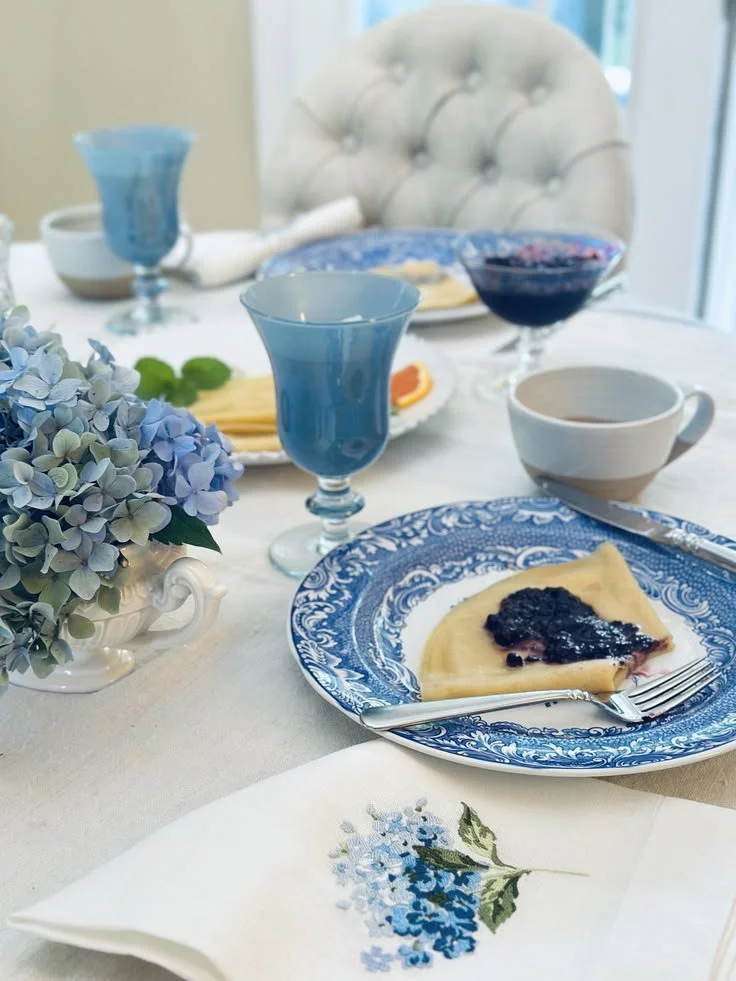
My daughter was home for the weekend, so on Saturday morning, the two of us sat down to an early brunch.
Setting a table for her is not unusual in this house. It is one of the things I like most to do, and I look for every chance I get because she is dear to me, and this is how I have always said so. A table tells someone how you feel about them before a single word is spoken over it.
So I was out in the garden early, cutting hydrangeas before the heat came up, and I carried them inside, put them into a small tureen, and laid two places.
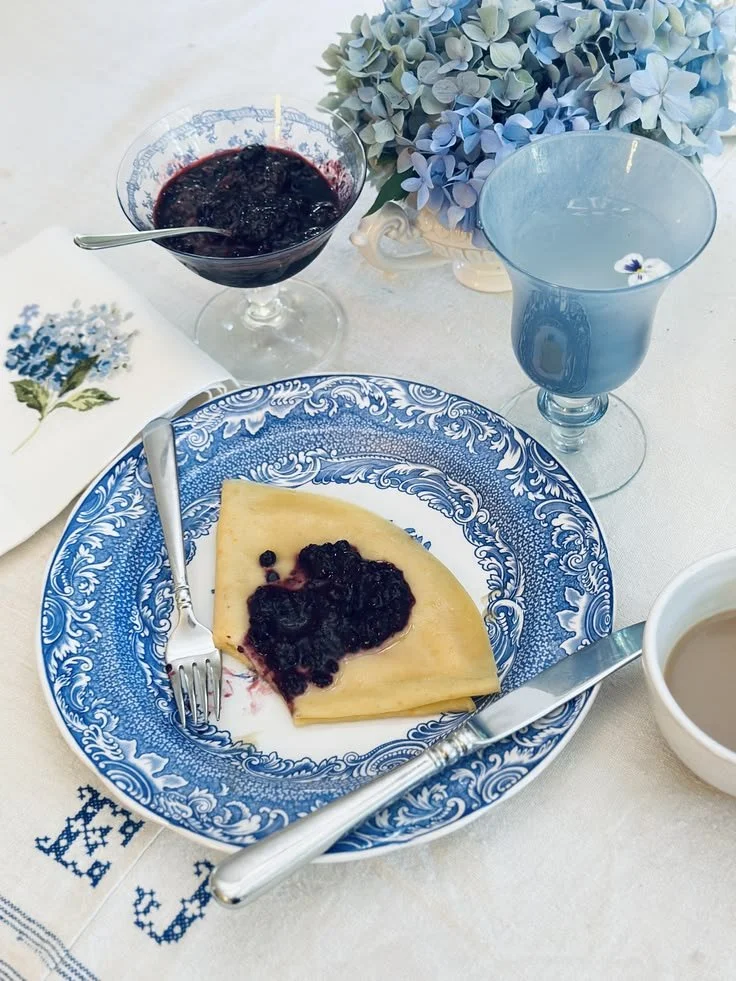
Then I made crêpes, with the berry compote my mother used to make and a little pitcher of warm maple syrup because it is her favorite thing in the world, and we sat there for a long while eating and talking the way we always do.
I have written out the whole table below, piece by piece, along with both recipes, in case you have someone coming home too.
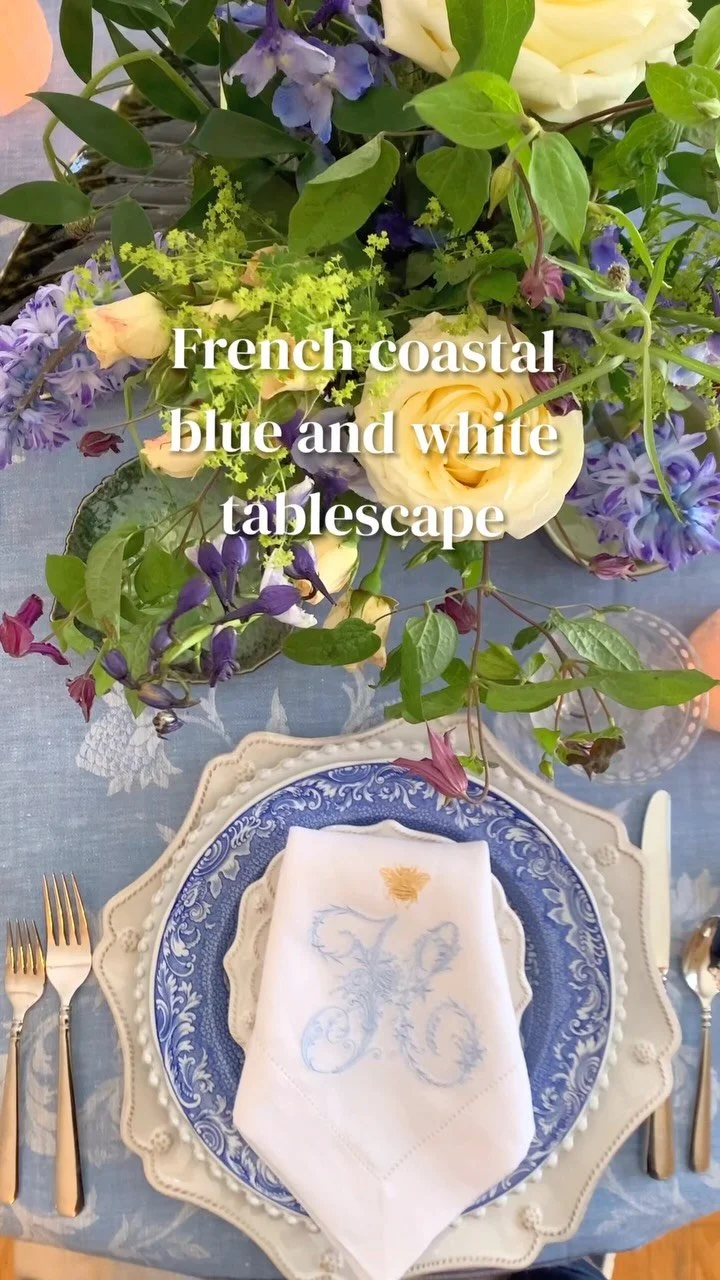
A Vintage Table Setting for Two
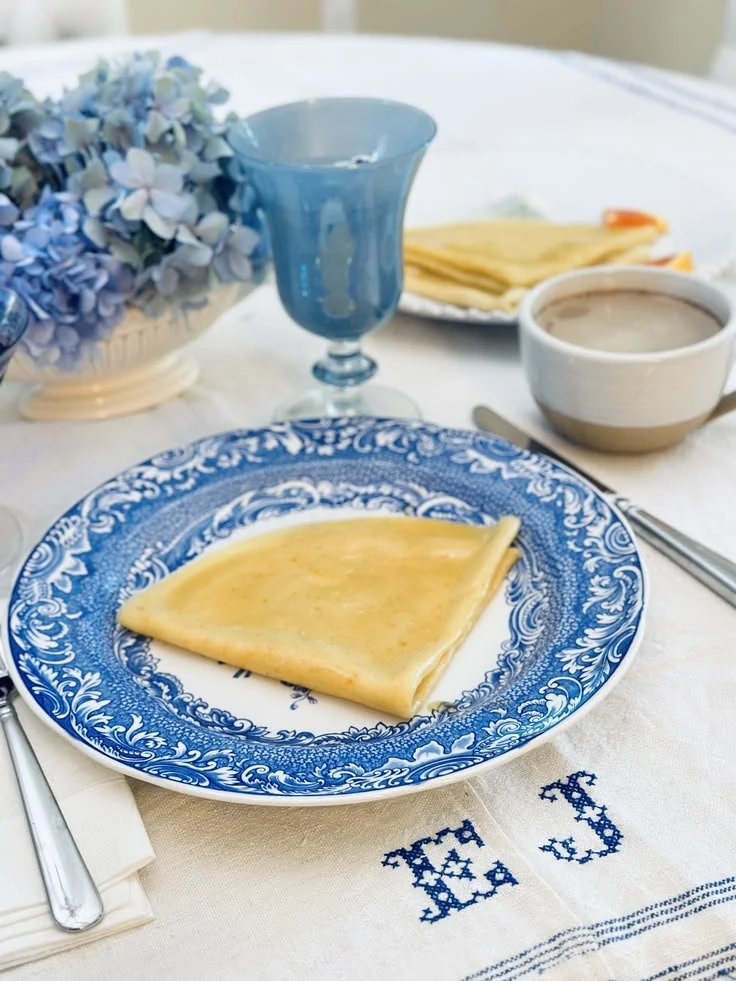
There is nothing on this table that was bought to go with anything else on it, which I suspect is true of most tables I set. A vintage tablescape is really just what happens to a person who has never once bought a matching set, and what holds it together is layering rather than matching. Antique linen underneath, transferware above it, everyday flatware alongside, and something living in the middle.
The Antique French Linen
The cloth came home with me from France, and it is one of the few things in this house I would not part with, a heavy linen woven with a navy stripe and finished with a cross-stitched monogram in one corner. The initials belong to somebody else entirely, and I have no idea who she was, which I find I rather like. I laid the plate down beside those letters instead of covering them, because they are easily the most interesting thing on the table, and it would have been a waste to hide them under a dinner plate.
The cloth is square, and my table is round, forty-seven inches across, and that mismatch turns out to be the part I love best about using it. A round cloth on a round table simply repeats the shape underneath it and disappears, whereas a square one falls in four soft corners that hang lower than the sides and give the whole edge a rhythm your eye wants to follow all the way around. It also means the cloth never had to fit in the first place, which is the only reason antique French linen works on modern tables at all, since every piece of it was cut a century ago for somebody else's furniture.
Do press it, though lightly. I run a warm iron over anything that goes on my table, and I always will, but I stop well before it starts to look new. That cloth has survived a hundred years because somebody washed it, pressed it, and folded it away properly, over and over again, and it will last another hundred on exactly the same terms. Caring for old textiles is not fussiness; it is the reason they are still here at all.
Blue and White Transferware
The plates are blue-and-white transferware that I found in an antique shop, and they were very reasonable, which I mention only because people tend to assume a table like this one must have cost a considerable sum. It did not. What it cost was attention, on an afternoon when I happened not to be looking for anything in particular.
I use those plates constantly, in every season, for company and for a quiet Tuesday alike, and I gave up apologizing for that a long time ago. Blue has always been my color muse, and these plates are where it lives in this house. Working with them makes me happy, which I have decided is a perfectly good reason to keep reaching for them year after year.
Blue and white china has moved in and out of fashion for the better part of three centuries without ever actually leaving, which is the whole argument for collecting it. Nothing you buy can date if it has never once been out of date.
My Everyday Lenox Flatware
There is no antique silver on this table. What you are looking at is my Lenox flatware, the set I reach for every single day of my life, and I want to say something about that because I think it matters more than any of the rare pieces do.
It is good enough to be beautiful. That is the whole standard, and once a thing meets it there is no reason on earth to keep it in a drawer waiting for a better occasion. I have watched a great many women set a lovely table and then apologize for the flatware, and I have never once understood it. If it is good enough to eat with, it is good enough to sit beside the plates you love.
The Embroidered Hydrangea Napkin
The napkins are white linen embroidered with a blue hydrangea, and they are among my favorites, particularly in summer, when I am out cutting the real ones every few days and treasuring each one. Setting the embroidered bloom a few inches from the living one is a small rhyme that almost nobody would consciously notice and that everybody feels anyway.
An embroidered or monogrammed linen napkin will always do more for a place setting than any elaborate fold ever could.
The Opaque Blue Glasses
The glasses are a deep opaque blue that you cannot see through at all, and that solidity is exactly what makes them work here. A clear glass on a table would simply disappear into the background, whereas these hold their own shape and color against the china's pattern.
I floated a single viola on the water in each one, sitting on the surface where you can see it from above. It takes about ninety seconds, and it is the detail my daughter noticed first.
I should admit that I chose the glasses first and then built the rest of the table around them, which is nearly always how a table comes together for me. You begin with one piece you genuinely love, and then you gather whatever agrees with it.
The Café au Lait Cups
The cups are wide and low and meant to be held in both hands, which is the entire point.
My daughter has a set of these at her own home and loves them, and I confess I did not see that coming. A generation raised on takeaway cups with lids has apparently decided it would rather hold something warm in two hands and sit still for a while, and I could not be more pleased about it. Whatever the reason, it means the cups on this table are ones she already knows.
A Hydrangea Centerpiece in a Small Tureen
What I wanted, more than anything else, was my hydrangeas indoors, and every other decision about the centerpiece followed from that one intention.
The tureen is a genuinely stunning piece, cream-colored and richly detailed, and it was never meant to hold flowers. I repurposed it, as I do with nearly all of my centerpieces. Its cream tone and its shape sit beautifully against blue hydrangeas without competing with them, which is more than most vases manage.
The size is what made it right. A proper arrangement would have taken up the entire surface of a small table and blocked the view straight across it, which rather defeats the purpose when the whole reason you are sitting there is to talk to the person opposite you. The tureen is small, with a wide mouth and a low shoulder, and it holds precisely one generous handful of blooms cut that same morning.
If I could offer only one piece of advice from this whole table, it would be this one: look for the vessel that is smaller than you think you need, and look for it in your own cupboard rather than in a shop. A tureen, a confit pot, a creamer, a sugar bowl. The everyday pieces hold flowers beautifully, and they hold them low enough that people can still see one another, which is the only measurement that really matters.
The container was never the point of any of it. The point was that the garden got to come inside and sit down with us.
A Crystal Pitcher of Warm Maple Syrup
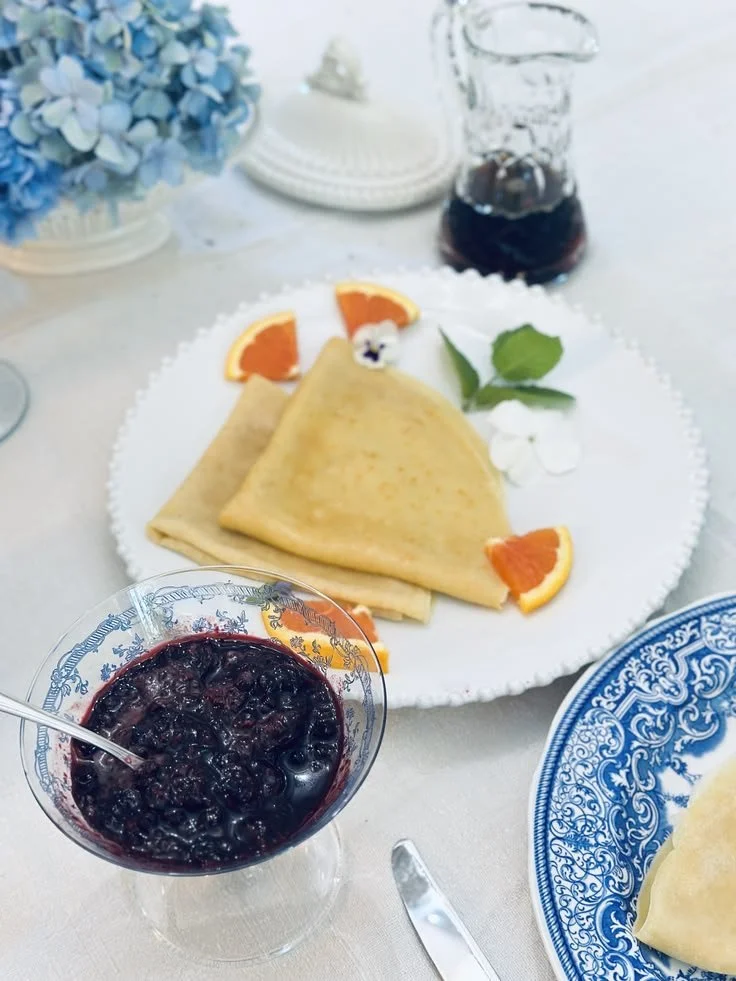
Beside the compote is a small crystal pitcher of maple syrup from Lamothe's Sugar House, our local sugar house here in Connecticut, and I warmed it before it came to the table.
This is my daughter's absolute favorite thing, and I would have put it out for her whether or not it suited the table. As it happens, it suits it because the amber catches the light in a way that nothing else on all that blue and white can, and a small crystal pitcher makes even an everyday thing look considered.
Warm it. Cold syrup on a warm crêpe cools the whole plate and stiffens the butter; warming takes about 30 seconds in the microwave.
Breton Crêpes: Galette or Crêpe de Froment
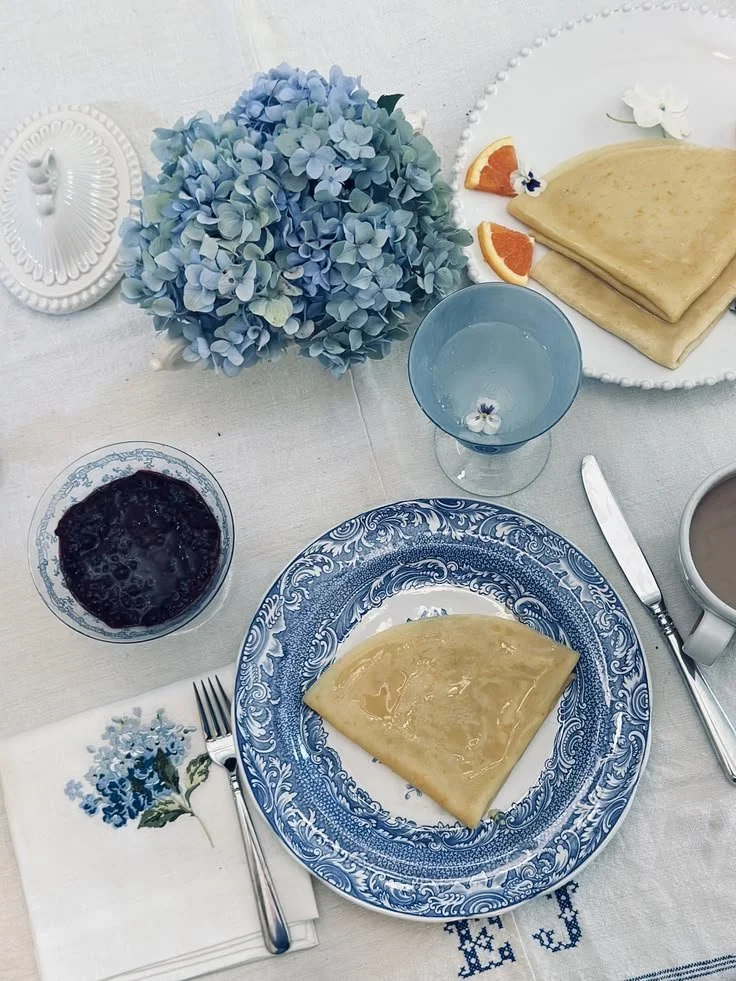
My mother was Breton, and in Brittany, the word crêpe means one of two quite different things depending on what you have put in the bowl.
A galette is made with buckwheat and is savory, filled with ham, egg, and cheese, and folded into a square at the corners. A crêpe de froment is made with wheat, and it is the sweet one, the one that arrives at the end. That distinction is not fussiness on the part of the Bretons; it is simply the difference between a meal and what comes after it.
The sweet wheat crêpe is also a good deal younger than most people assume, since it did not really appear until the end of the 1800s, and before that, Breton crêpes were made of black wheat and eaten as supper rather than dessert. My mother's buckwheat pancakes, served with compote spooned over them, sat far closer to that older tradition than these crêpes of mine do.
Traditional Breton batter is scented with rum or orange flower water or vanilla, and it is made with salted butter, which is genuinely the ingredient that makes a crêpe Breton rather than simply French.
The orange zest, I should be honest, is mine. It is not what my mother did, and it is not what any crêperie in Quimper would put in the bowl. I add it because it lifts the whole crêpe and fills the kitchen with a smell worth getting out of bed for, and I am calling this recipe my own on the strength of that zest, the honey-and-butter finish, and the small batch size. The bones of it are Breton. The hand is mine.
French Crêpe Recipe: Crêpes de Froment à l'Orange
Makes about eight thin crêpes, which is a generous brunch for two.
1 cup all-purpose flour
2 tablespoons sugar
1 pinch fine sea salt
2 teaspoons fresh orange zest
2 large eggs, room temperature
1 cup whole milk, gently warmed
3 tablespoons water
½ teaspoon vanilla bean paste
2 tablespoons salted butter, melted and cooled to warm
To finish: 1 tablespoon salted butter, melted, and 1 tablespoon honey
Start with the wet batter. Rub the orange zest into the sugar with your fingertips first, which releases the oils and carries the orange much further through the finished batter than simply stirring it in ever will. Then whisk the eggs, the sugared zest, the salt, and the vanilla together in a large bowl until smooth.
Add the butter, then half the milk. Whisk in the melted butter while it is warm rather than hot, or it will begin to cook the eggs. Then whisk in about half the milk, which should be gently warmed as well, since cold milk poured onto melted butter will set it into small flecks you cannot whisk out afterward.
Add the flour gradually. This is the step to take slowly. Add the flour in three or four additions, whisking constantly and letting each one disappear completely before the next goes in. Shaking it in through a sieve rather than tipping it from the cup makes a real difference. Flour added all at once to a thin liquid clumps on contact and forms a skin that seals the dry flour inside; once that happens, no amount of whisking will fix it.
Add the rest of the milk and water. Once the batter is perfectly smooth and rather thick, whisk in the remaining milk and the water until it runs like heavy cream.
Rest it in the refrigerator. Cover the bowl and leave it for at least an hour, though overnight is better, and the aromas come forward considerably with time. This is the step everyone skips, and it is the one that matters most, because the flour hydrates fully and the gluten relaxes, and that is precisely the difference between a crêpe that tears and one that folds.
After the batter rested. Take the batter out 15 to 30 minutes before you plan to cook, and stir it from the bottom, since the flour settles as it rests, and cold batter will not spread cleanly. If it has thickened overnight, thin it with milk a tablespoon at a time until it runs like heavy cream again.
Cook them gently. Heat your pan over medium heat, no higher, because there is sugar in the batter and honey coming later, and both will scorch. Wipe the pan with a little butter, pour the batter into the center, and spread it in one smooth pass or tilt the pan to coat. Give it about a minute on the first side, until the edges lift and loosen, then only a few seconds on the second.
Finish at the last moment. Stir the honey and melted butter together, then brush each crêpe just before it reaches the plate, while it is still warm enough for the glaze to soak in rather than sit on top.
The first crêpe is always a sacrifice in every kitchen in the world, and all it really tells you is whether your pan is running too hot. Do not judge the batch by it.
My Mother's Berry Compote: A Family Recipe Passed Down
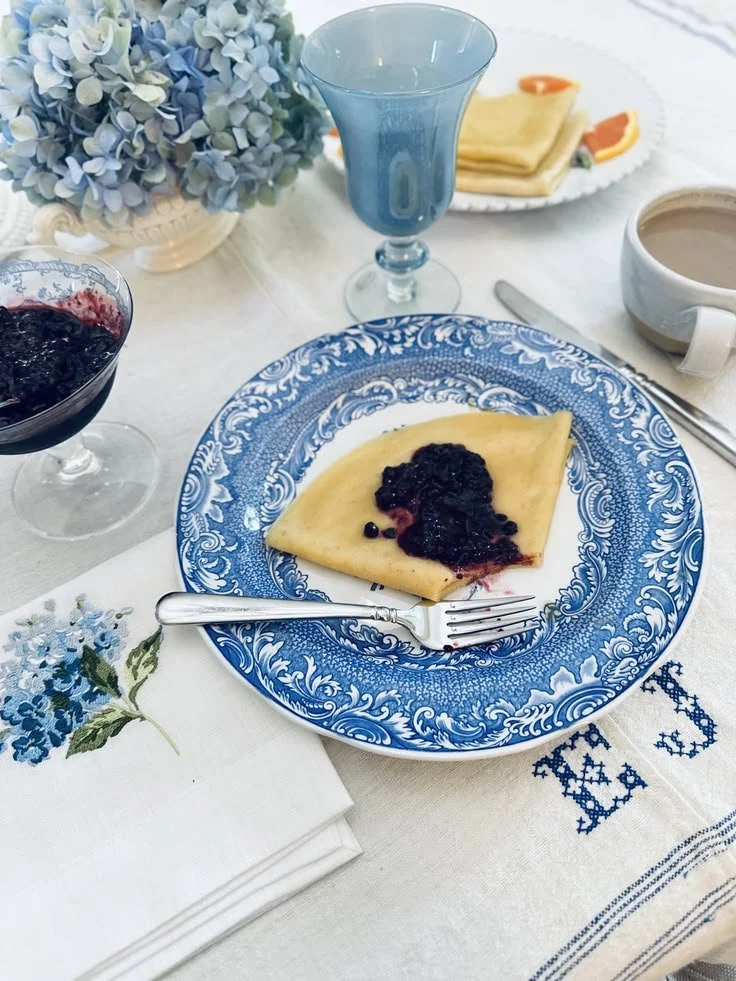
Berries simmered down with honey and a little vanilla, dark and loose and barely sweet, are what my mother made whenever she wanted something sweet without turning it into a production. It went over her buckwheat pancakes, over toast, and sometimes straight from the jar with a spoon while she stood at the counter.
She used honey rather than sugar, which is the older way of doing it, from before commercial sugar had reached every kitchen in France. I use frozen berries, which are every bit as good as fresh once they have simmered down, and which means I can make this in the middle of February when I need it most.
2½ cups frozen mixed berries
1 to 2 tablespoons of honey, depending on your sweet preference
½ teaspoon vanilla bean paste
1 pinch salt
Put everything into a small saucepan over medium heat, straight from the freezer, and let it simmer for 10 to 15 minutes, stirring now and then, until the berries break down and release their juices. (Watch while cooking so that it doesn’t get too thick. Once it cools, it will become a bit thicker.) Mash it with a potato masher until it reaches the desired texture, then let it cool and keep it in a glass jar in the refrigerator for up to a week.
Spoon it over the crêpes while they are still warm, and let a little run over the edge and onto the plate, because that is not a mistake. My daughter takes the warm maple syrup over hers as well, and I have long since stopped arguing about whether two sweet things at once is one too many.
There is something I only noticed while I was spooning it out that particular morning: my mother made this compote, and I make it now, and I was standing there putting it onto my daughter's plate. Three women and one small saucepan of berries and honey, across more years than I care to count, and nobody ever wrote a word of it down. It simply kept going.
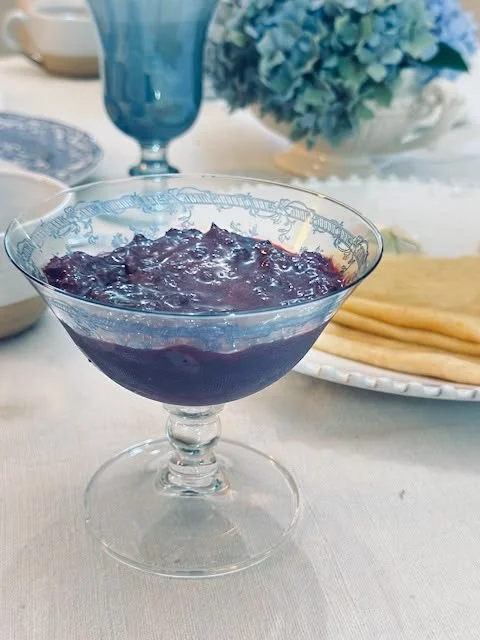
I think that is what a recipe passed down actually is. Not a card in a box somewhere, but a thing one person keeps doing until somebody else quietly picks it up.
Why I Take the Trouble
We sat at that table a long while, far longer than the crêpes took to make and much longer than either of us needed to eat, which is the part of the morning I would keep if I were only allowed to keep one thing about it.
What I did not expect, and what I am still turning over, is that my daughter has become a considerable cook and hostess in her own right. She loves to feed people. She loves having them at her table and looking after them once they arrive. Somewhere along the way, this stopped being something I did for her and became something the two of us do, which is a quieter and better outcome than anything I was consciously aiming for.
I often think about what we are really doing when we take trouble over a table.
It is not decoration, and it is not performance, whatever anyone tells you. It is a way of telling somebody that they were worth the effort, said in a language that does not require either of you to find the words out loud. My daughter knows perfectly well what the good plates mean. She has known since she was small, and now she says it back to her own friends in the same language.
So make the crêpes, cut the hydrangeas, and lay the table properly for the people you would most like to say something to, but cannot always say it to directly. Some of them will be listening more closely than you realize.
Design with the Heart™
À bientôt,
Mary
Questions I Am Often Asked
What is the difference between a galette and a crêpe de froment?
A galette is made with buckwheat flour and served savory, most often with ham, egg, and cheese, folded at the corners. A crêpe de froment is made with wheat flour and served sweet. In Brittany, the two are treated as separate dishes rather than as variations of one.
Why does crêpe batter need to rest?
Resting lets the flour hydrate fully and the gluten relax, which helps keep a crêpe from tearing when you spread it. An hour in the refrigerator is the minimum; overnight is better, as the flavor develops.
What makes a crêpe Breton rather than simply French?
Salted butter, above anything else. Traditional Breton batter is also scented with rum, orange flower water, or vanilla rather than left plain.
What is blue and white transferware?
Transferware is earthenware or porcelain decorated by transferring an inked engraving onto the piece before glazing, a process that enabled detailed patterns to be produced at scale from the late 1700s onward. Blue and white are the most common and the most collected colors.
How do you care for antique French linen?
Wash it gently, press it lightly with a warm iron while it is still slightly damp, and roll it away rather than fold it. The goal is a cloth that looks cared for rather than one that looks new.
What size centerpiece works on a small table?
Smaller than you think. A vessel with a wide mouth and a low shoulder, holding a single handful of flowers, sits below eye level, leaving room for the plates. A tureen, confit pot, creamer, or sugar bowl all work beautifully.
Do you need special flatware for a table like this?
No. Mine is every day, Lenox, and it goes on the table every day of the week. If it is good enough to eat with, it is good enough to set beside your best plates.
Shop This Table