A Room That Honors Her Past and Present: How I Updated My Daughter's Bedroom for Who She Has Become

The quiet work of holding space for a daughter
The bedroom belongs to my daughter even though she no longer lives here. She visits often from Washington, D.C., where she has built her life, and when she returns, she comes through the door of this room to recharge from the hustle and bustle of her city days. The room had to do a particular kind of work. It had to honor who she had been when this house was her home, and it had to welcome who she has become in the years since.
Updating a child's bedroom for a young adult daughter is more delicate than it might appear. The room cannot pretend her childhood never happened. Neither can it preserve her childhood so completely that she feels she has not been allowed to grow. The work asks a mother to hold both — what was, and what is — in the same physical space.
The Furniture That Has Always Been Hers
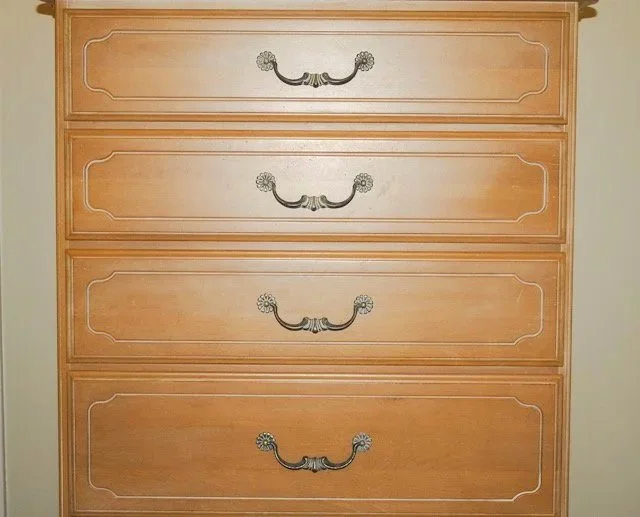
The furniture in the room was bought for her when she was a child. Solid birch — substantial, heavy, painted in a soft light wood color with the differential streaking that gives a hand-applied finish its quiet movement. The pieces have been with her since girlhood.
When I bought them, I was thinking past the moment. I did not want furniture that she would outgrow at twelve, sixteen, or twenty. I wanted pieces that would carry her into her adulthood — pieces she could one day take with her into a home of her own, and that her children, when she has them, might know as the furniture of their mother's girlhood.
That kind of long view is the quietest form of love. You spend on the piece that will last. You choose what your daughter will be able to take with her when she leaves. You buy the dresser knowing it will outlive your part in her story.
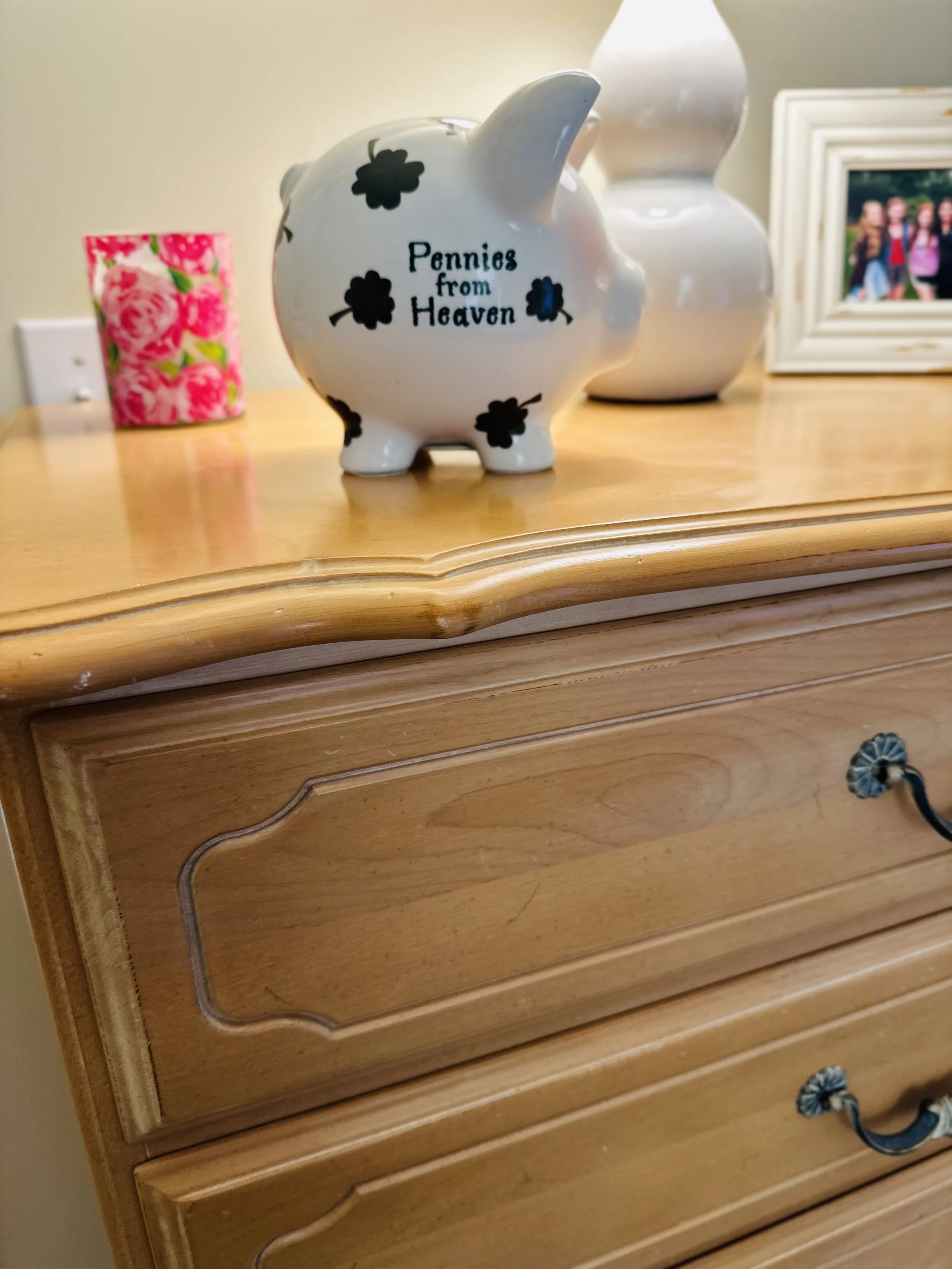
On top of one of the chests, she keeps the things that are hers alone. Her original piggy bank from childhood. A few photographs that matter to her. A candle. I did not place these. She did, on her own visits home. The room is not just designed for her. It holds the objects she has chosen to keep. That is the difference between a room a mother makes for a daughter and a room a daughter has made her own.
Inside the drawers, the room holds something deeper. I kept everything she cherished most. The ballet outfits from every year of her dancing life. The memorabilia from her years at Miss Porter's School in Connecticut, where she spent her high school years and where the girls have worn Lilly Pulitzer for generations — a school Lilly herself attended, a brand and an institution that grew up together. The dresses were not just clothes. They were the visual language of the friendships she made there — the sisters she found at the school that shaped her early.
The years that followed brought another community. She went on to American University, where she joined Delta Gamma and built a new network of women, different from the Miss Porter's circle, but with the same essential quality. Women who would become part of her ongoing life. The sorority memorabilia is kept in the drawers alongside everything else. The pins, the photographs, the small artifacts of those years.
I did not sort any of it out or send any of it away. I kept everything in her drawers, in her room, where it all remains part of her ongoing presence in this house. If she has a daughter one day, perhaps a small girl will wear the Lilly Pulitzer dresses her mother once wore. Perhaps the ballet outfits will be folded into the hands of someone who has only just begun to learn what a barre is. Perhaps not. The things we keep because what we keep tells our daughters who we believe they are worth being. What you save for the next generation is its own quiet form of design.
The birch furniture remains here. It anchors the room across decades. Inside the drawers is the history of her girlhood — the schools she attended, the women she met along the way, the friendships that shaped her. On top is what she has chosen to bring with her. The room is the visible part. The drawers are the invisible part. Both belong to her.
Replacing the Canopy Bed with a Vintage Iron Bed
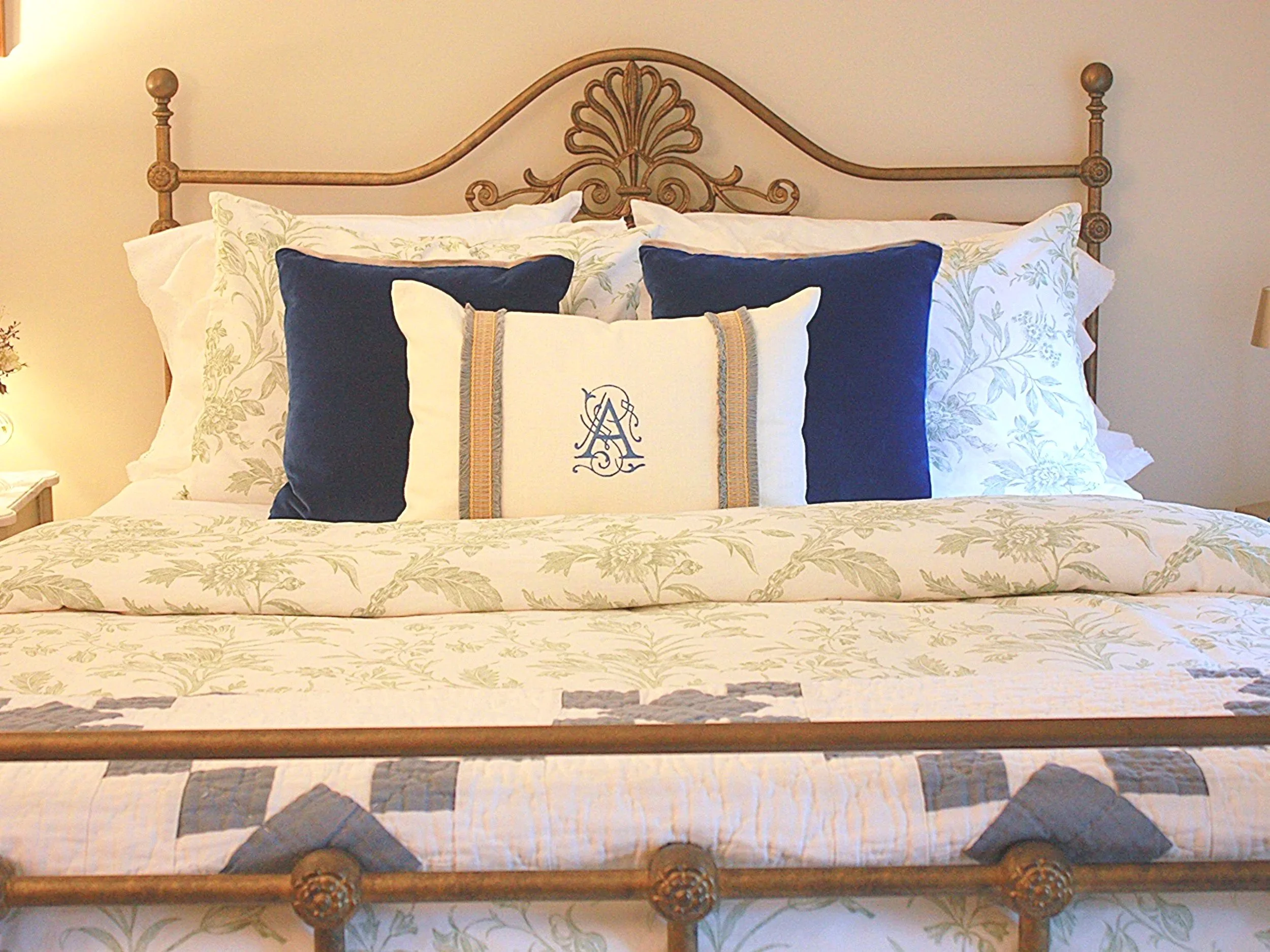
The first piece I changed was the bed. The canopy bed of her childhood was beloved, but it was a girl’s canopy bed, not a young woman’s returning home from a city career. I replaced it with a vintage iron bed — softer in line, less formal, the kind of bed that ages into a room rather than fighting it.
The iron bed allowed me to layer everything else. It does not demand attention. It simply holds the space and allows the bedding, the gallery wall, and the small details around it to speak for themselves.
A Persian Carpet to Anchor the Room
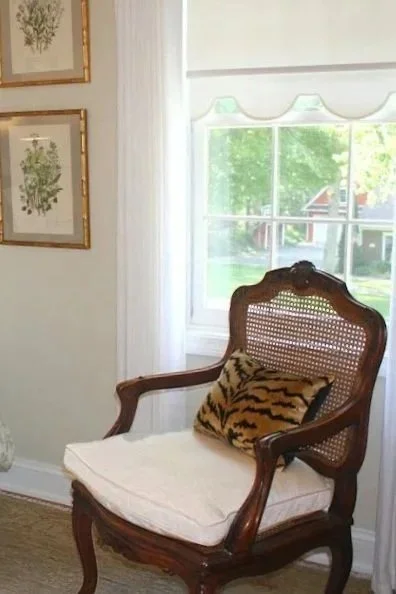
The Persian carpet is what anchors the room. Its soft blues, greens, ambers, and creams hold every other color in conversation. The antique French cane-back chair with its custom semi-silk cushion sits atop it. The small leopard pillow on the seat picks up the carpet's tones — a quiet act of visual repetition that makes a room feel composed rather than assembled.
Nothing in the room is matched. Everything is in conversation.
The Toile Bedding and the Layered Pillows
The bedding is the place where the room teaches its truest lesson. Each layer is a choice. Each choice serves more than one purpose.
The foundation is white percale linens — crisp, breathable, the bedding of good hotels and considered homes. Beneath the toile duvet, I added a white textured coverlet so that in the summer months, when the duvet feels too heavy, she has the option of something lighter against her skin.
The toile duvet is French in spirit and classic in pattern — the kind of bedding that does not date itself.
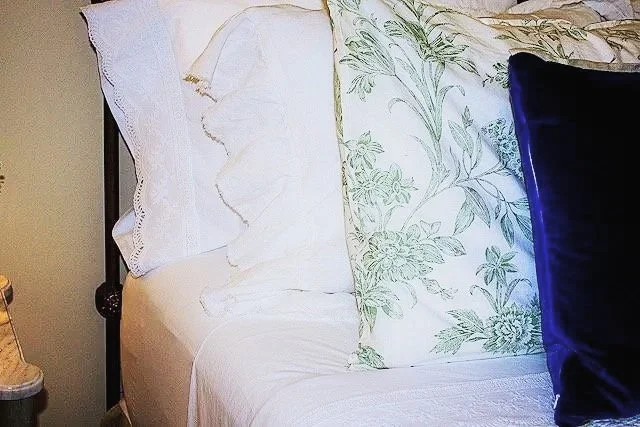
The pillows are built from the headboard forward in five distinct layers.
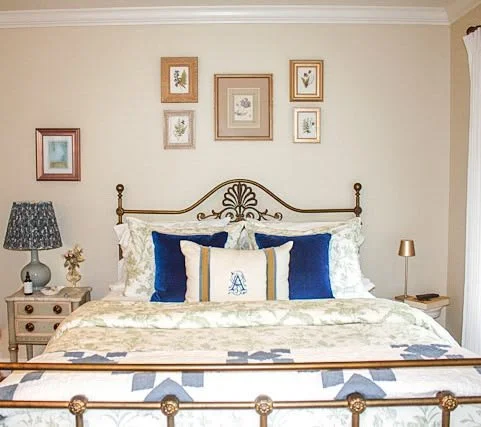
Closest to the headboard, percale pillows trimmed with a gorgeous lace edge anchor the back of the bed with quiet vintage softness. In front of those, white linen pillows with ruffled edges bring a note of French country sensibility. The toile shams come next, repeating the duvet's pattern and pulling the bed's color story forward. Then two vibrant deep blue velvet throw pillows — chosen for depth, and for the way the blue draws color from the Persian carpet, the lampshade above the nightstand, and the quilt at the foot of the bed. The blue echoes through the room and back into the bed, making the design feel unified rather than placed.
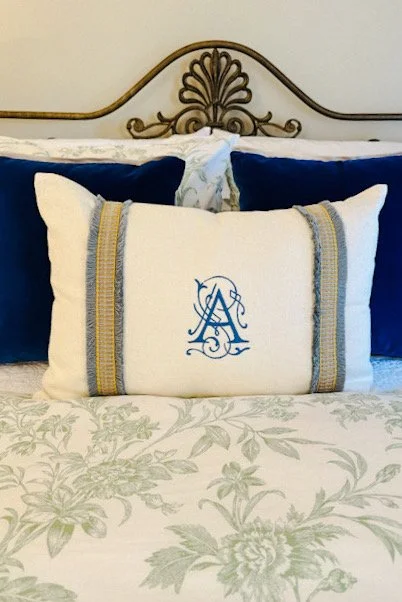
At the very front, closest to where her hand would rest, was the monogrammed pillow. Her initial in soft cursive script — the A embroidered in blue, with decorative details on each side that pick up the same color. The blue of the A and the velvet pillows behind it speak to one another. The pillow is placed where she will see it first.
The monogram is small. The pillow is one of many. But it tells her, every time she returns to the room: this bed knows your name.
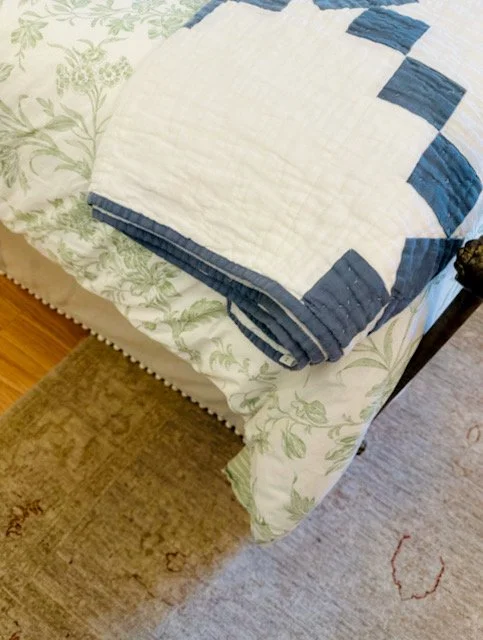
Beneath all of this, the bed skirt is a soft light green chosen to echo the green threads in the toile. Cream pom-poms at the hem catch the toile's cream ground. These are the choices the eye almost fails to see, yet the room would feel different without them.
At the foot of the bed lies a white and blue patch quilt. She uses it when she wants to watch television or take a nap — heavy enough to comfort, soft enough to disappear into when she needs to disappear. It carries the blue-and-white color story forward. It honors the tradition of patchwork as an American craft. And it gives her a way to wrap herself in something familiar when the day has been long.
It is the details that matter.
The Ballerina Painting
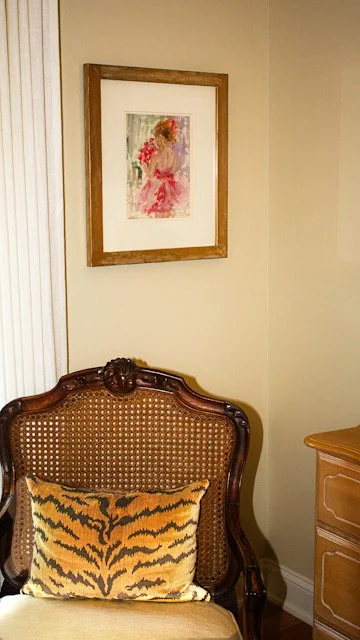
The painting hangs adjacent to her bed. A small girl in a pink tutu, hair pulled into a ballet bun, dressed entirely in pink. The piece was made by Elizabeth Lines — an artist whose work I admired long before I owned anything of hers. Her Instagram is @elizabethmlines, and her paintings carry a feeling that does not come from technique alone. They carry the feeling of someone who has watched girls dance.
My daughter has been a dancer for most of her life. The hours at the barre, the recitals, four years dancing for Miss Porters, the slow build of muscle memory into something that looks like grace — all of that is part of who she has become. She does not live the dancer's life now. But the dancer is still in her, the way every former version of ourselves is still in us, quietly shaping how we move through the world.
The painting came with a plain white frame. I did not like it. The white felt out of place given the room's warmth and the piece's depth. So I gilded the frame gold myself — slowly, in thin layers, until the color became right. That is the work of designing a room. You are not always given what serves you. Sometimes you must change what you have been given.
The painting hangs in her room, not because it is decorative but because it is true. It tells her every time she returns: I see who you have been. I have not forgotten.
The Framed Pressed Flowers from Her Garden
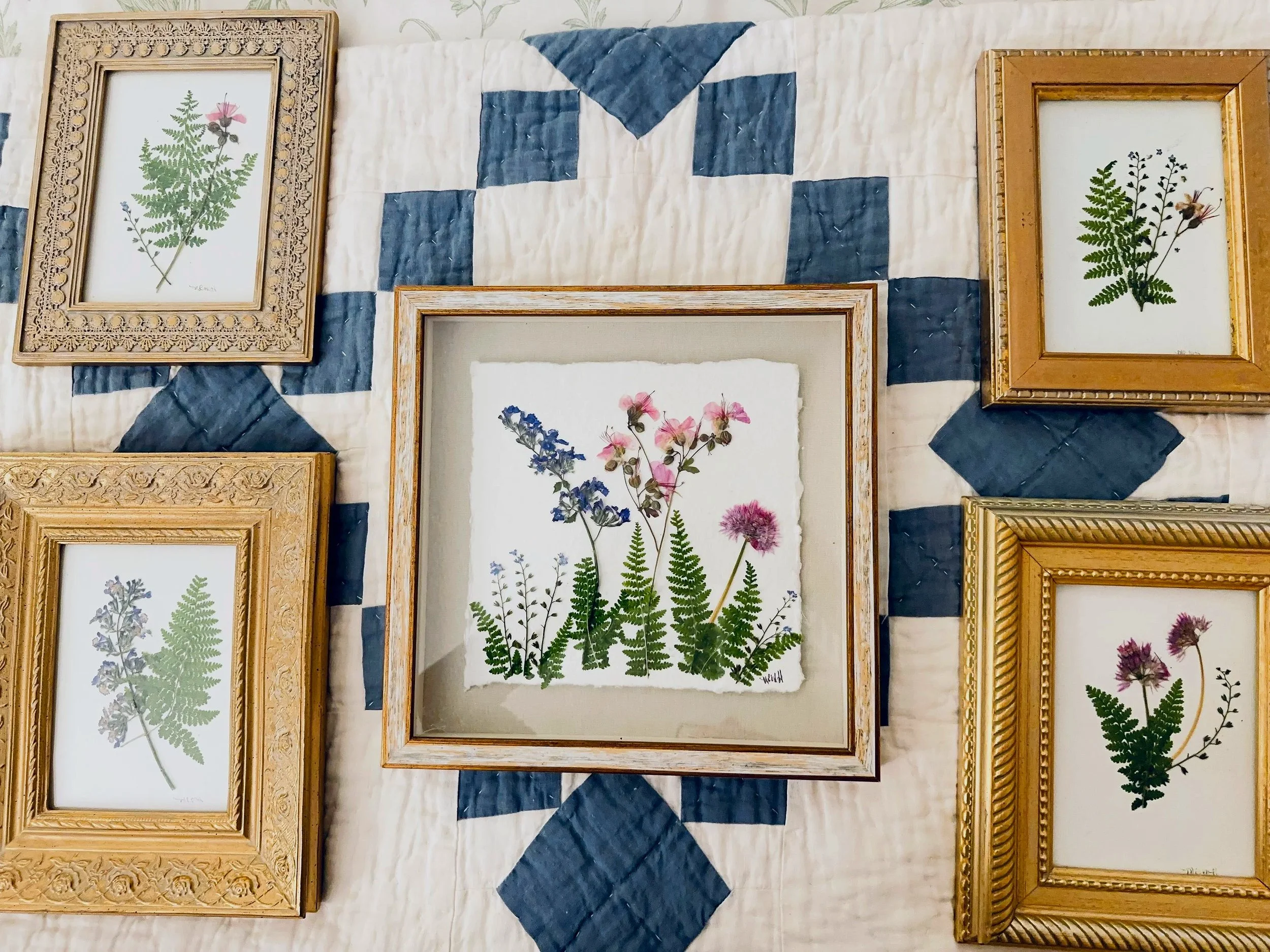
I pressed and framed the flowers from her garden myself. These are the first pressed-flower pieces I have ever made, and they were created as a memento for her — small acts of preservation for the plants she grew and tended at home over the years.
She has been a naturalist at heart since she was small. The flowers she planted were chosen for the butterflies, dragonflies, and bees they would attract. The garden was her first design project. The ferns growing along our property have been part of her landscape.
The single piece holds a delphinium, a geranium, a fern, and a chive blossom. The chive blossoms come from my mother-in-law's garden. She gave us a clipping years ago, and the chives still return every spring — three generations of women now connected through one small purple flower that keeps coming back.
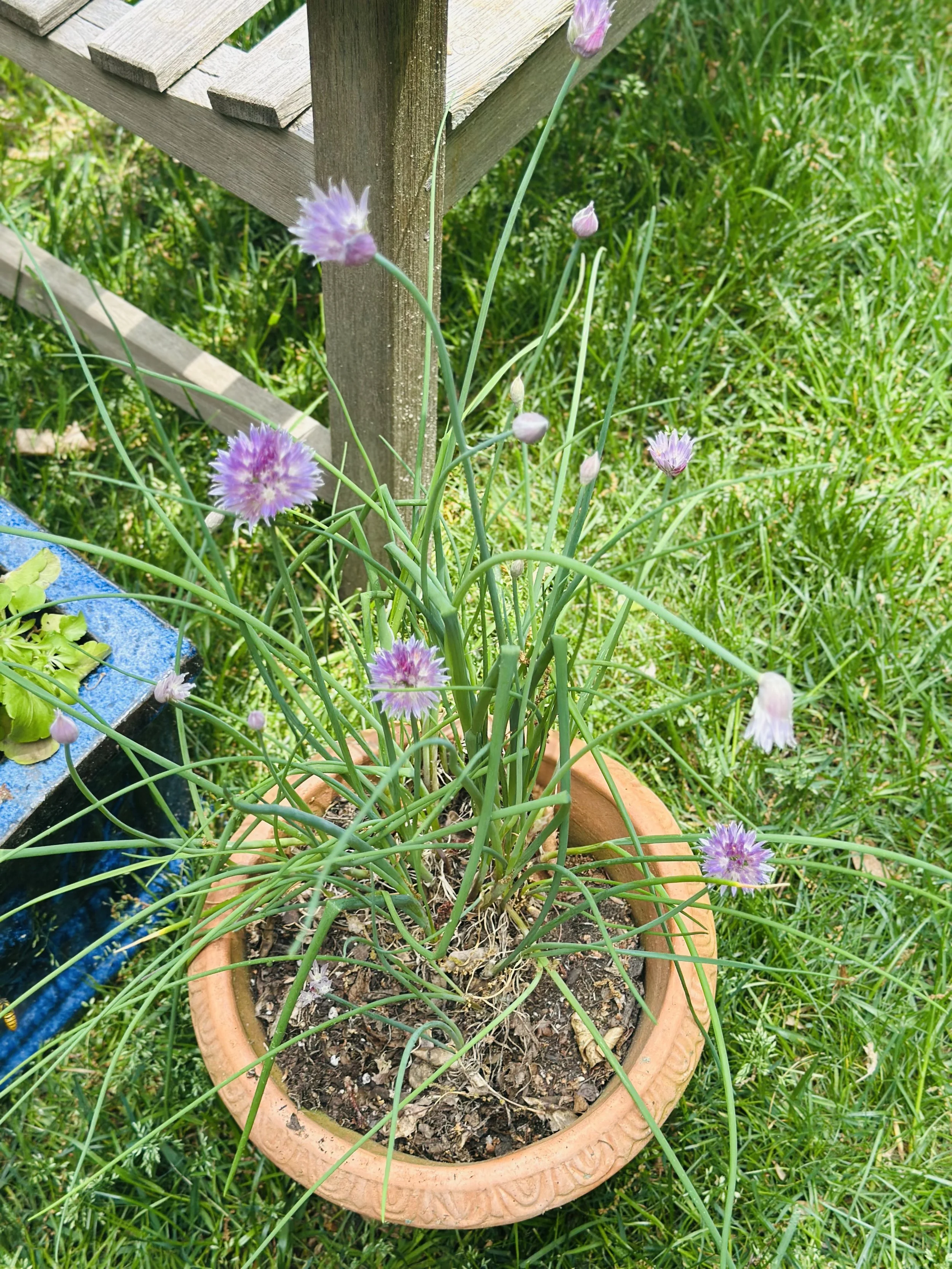
The same chives are blooming this week as I write this. The ferns are unfurling along the property line, the way they have every spring of her life. The pressed flowers on her wall are not just decoration. They are the still moments of plants that continue to live and bloom, in the same garden, season after season.
The Soft Linen Curtains and the Wall Between the Windows
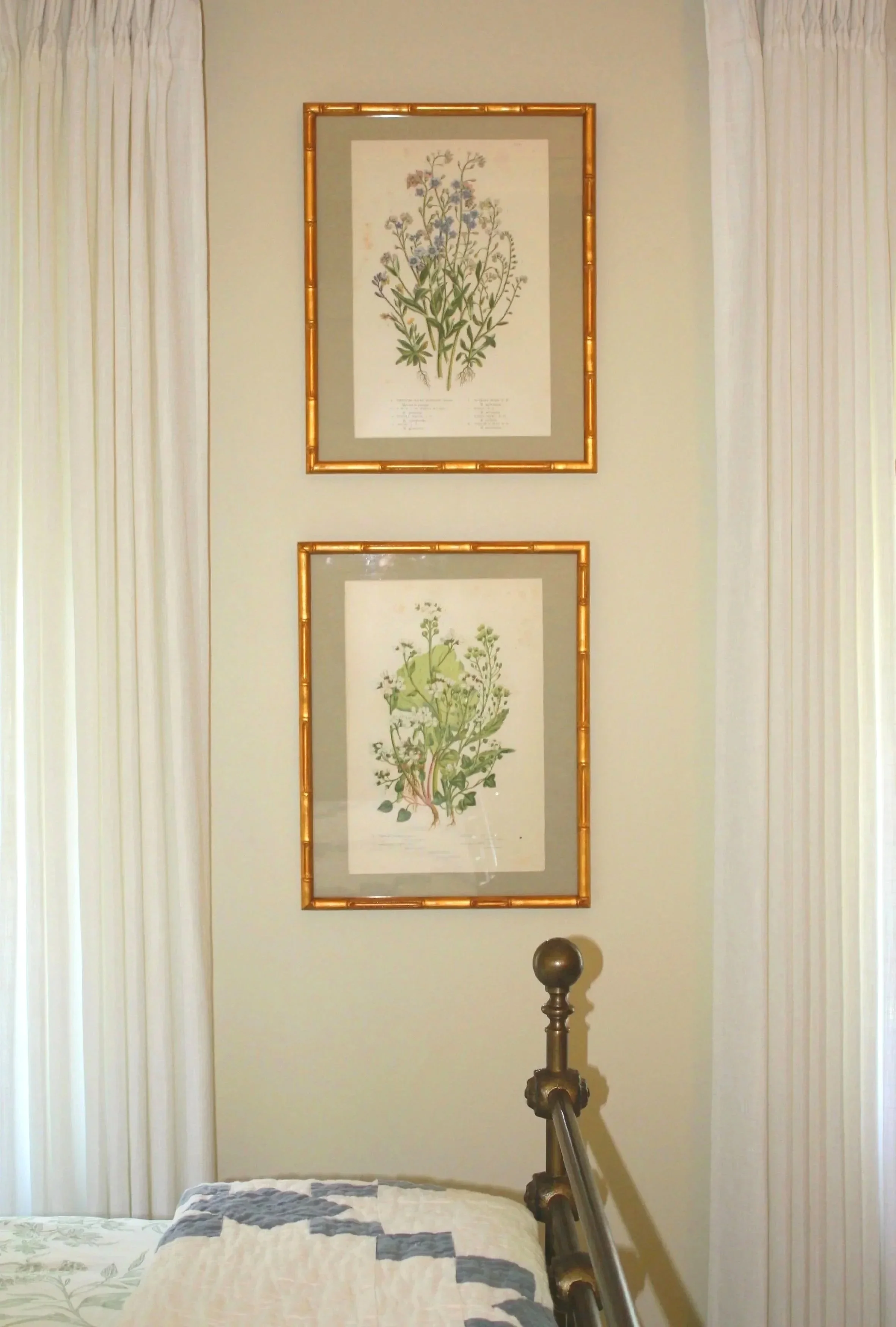
The linen curtains hang on both sides of the windows — soft and unstructured, the way curtains in French country rooms are. Between the windows, in the narrow wall space that another room would have left empty, two botanical prints in gold bamboo frames fill the air. The light green mattings on the prints echo the green threads in her bed skirt, the green notes in the toile duvet, and the soft greens scattered through the Persian carpet.
Everything in the room is quietly speaking to everything else.
Two prints stacked vertically rather than one centered is the choice that gives the wall its proper visual weight. Single prints on narrow walls often look like afterthoughts. A vertical pair fills the space the way the room asks to be filled.
The Small Details That Make the Room Hers
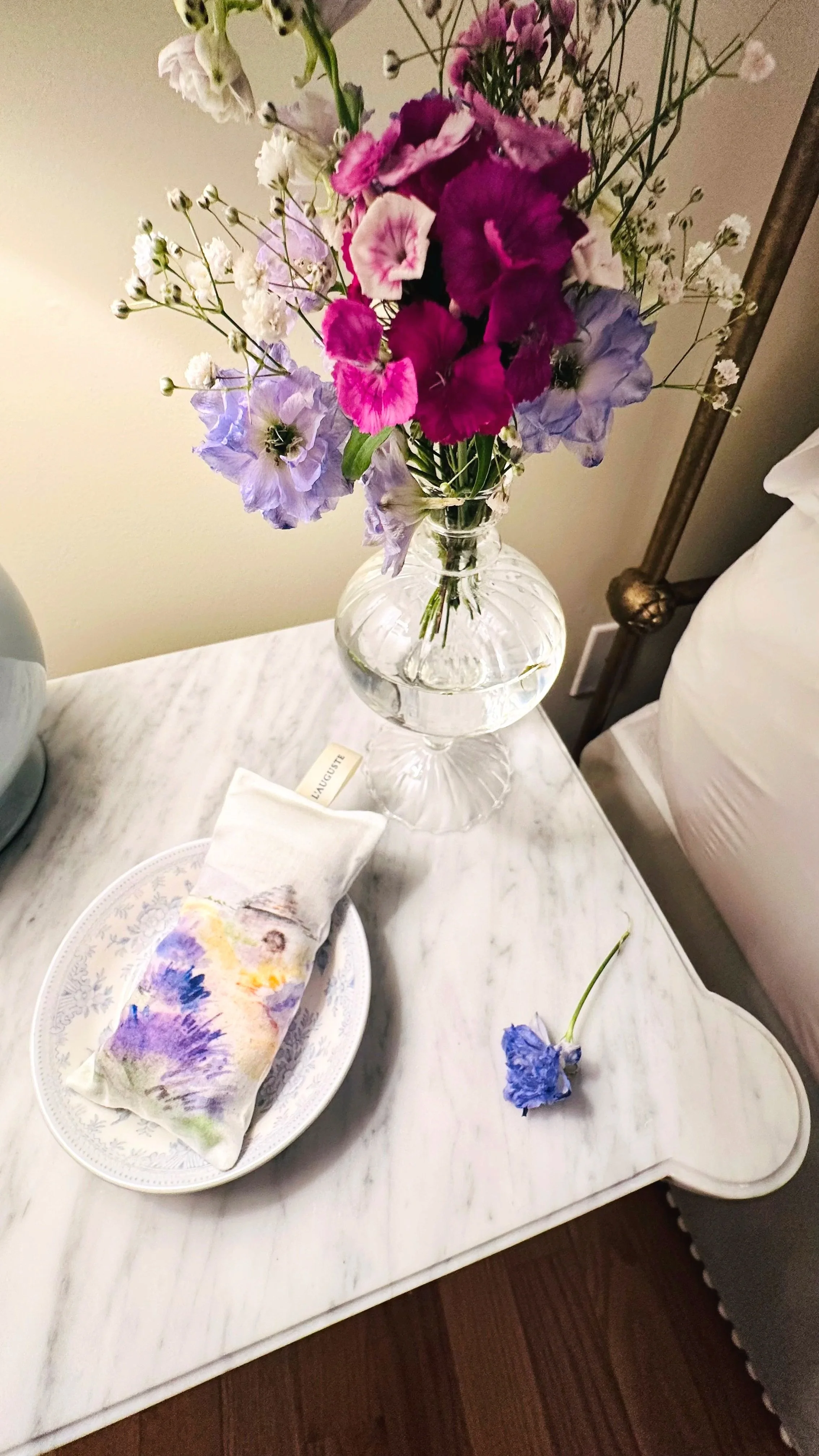
On the marble top of the Etienne nightstand from Frontgate — a piece with a French patina finish that softens with age — small moments of care gather. A clear bud vase holds the first spring wildflowers from her garden. A Blue Asiatic Pheasants dish from England cradles a lavender sachet from L'AUGUSTE in Provence, two heritages quietly meeting on one small surface. A single blue bud rests on the cool marble, waiting for nothing in particular. Above, the floral blue cloth lamp shade brings color and softness to the corner.
These are not styling tricks. They are acts of attention. The room is a sanctuary because someone has tended to it.
A Sanctuary She Returns To

The room is her recharging space after the city days. She comes home from D.C., and she comes through the door of this room, and the weight begins to settle.
I wanted that for her. I wanted a room that would hold her past and her present in the same space and welcome her every time she returned. I wanted the iron bed and the toile and the pressed flowers from her garden and the gilded ballerina painting and the Etienne nightstand and the linen curtains and the small artifacts on her dresser top to all do one quiet thing together — to tell her that she is home.
The years ahead will bring whatever they bring. She may move farther. She may marry. She may have a daughter of her own. Until then, the room holds her past and her present in the same space. It welcomes her every time she returns.
That is the work I set out to do.
Live beautifully. On purpose.
Design with the Heart™.
À bientôt,
Mary